
Do You Need Schema Markup? What It Actually Does for Local Businesses
Schema markup is one of those topics that gets either wildly oversold or completely ignored. If you have been wondering “do I need schema markup,” the honest answer is yes, but not for the reasons most people think.
Here is what schema markup for local business websites actually does, what the research shows about structured data and AI citations, and which schema types genuinely matter.
What Schema Markup Actually Is
Schema markup is code added to your website that tells search engines and AI tools exactly what your content means, not just what it says. It is the difference between human-readable and machine-readable.
Without it, Google and AI engines have to guess. A page that says “we serve the greater Houston area” requires interpretation. A page with LocalBusiness schema that explicitly states your name, address, phone number, service area, and business type requires no interpretation at all. You have turned your business into a clearly defined entity instead of a block of text the machine has to decode.
That distinction matters more now than ever. Schema markup is the technical layer that influences whether AI Overviews and Gemini cite your content or pass it over, regardless of how strong your content strategy is. Strong content with no schema still underperforms strong content with schema, because structured data removes the ambiguity that reduces citation confidence.
What the Research Shows About Structured Data and AI Citations
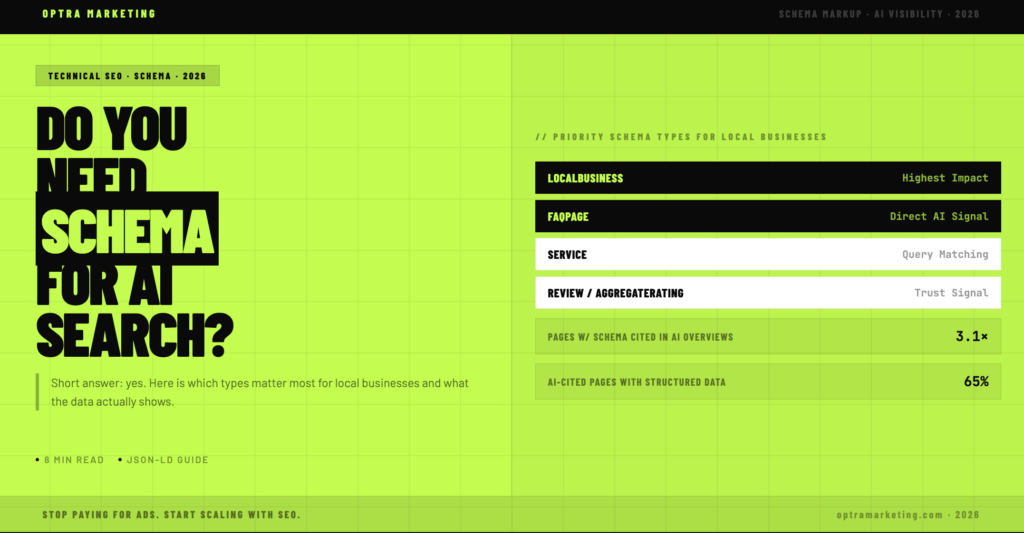
The data on structured data for SEO and AI visibility is consistent across multiple studies. Pages with structured data are cited up to 3.1x more often in AI Overviews, and roughly 65% of AI-cited pages include structured data. That second figure is correlational rather than causal, but the pattern is too strong to dismiss: the pages AI systems trust enough to cite overwhelmingly tend to be the ones that are easy to parse.
There is also a more significant recent finding. AI Overview citations from top-10 ranking pages dropped from 76% to 38%, which means lower-ranked pages with strong structured data now regularly win citations over higher-ranked pages without it. That is a genuine levelling effect. A smaller business with proper schema markup is now competing on more equal footing with larger, higher-authority sites in AI results, something that was nearly impossible in traditional rankings.
The honest caveat: schema is a contributing signal, not a magic switch. AI source selection weighs structured data quality as one input alongside authority signals, content freshness, and query relevance, and at least one large-scale study found that adding schema to otherwise unchanged pages moved citations very little on its own. Sites with comprehensive, accurate schema that passes validation are advantaged at the margin, not because schema alone drives citation, but because it removes the uncertainty that would otherwise reduce selection confidence. Schema amplifies good content. It does not rescue weak content.
Which Schema Types Actually Matter for Local Businesses
Not all schema is equally valuable, and most of the 800+ types in the schema.org vocabulary are irrelevant to you. For a local service business, the priority list is short.
LocalBusiness, or a specific subtype. This is the single most important schema markup for local business visibility. It explicitly tells Google and AI tools your business name, address, phone number, service area, opening hours, and business category, the exact fields AI engines check when validating whether you are a real, recommendable business. If you implement nothing else, start here.
FAQPage. FAQ schema has the highest immediate impact on AI visibility because it directly signals answer-structured content, the format AI systems prefer to extract. Keep each answer between 40 and 80 words: substantive enough to be useful, short enough to be lifted cleanly into an AI-generated response.
Service. Describing your specific services in machine-readable form helps AI tools match your pages to relevant queries. This matters most for service-specific searches, “drain cleaning in Centreville,” rather than searches for your business name, which is exactly where new customers come from.
Review and AggregateRating. Showing your review score in structured data reinforces your trustworthiness as a citation source, and it can trigger star ratings in traditional search results, which lifts click-through rates as a bonus.
The Format That Works in 2026
Every major AI engine prefers JSON-LD because it sits cleanly separated from your page content, making it easy for both crawlers and AI systems to extract. Avoid Microdata and RDFa for any new implementation. JSON-LD in the page head is the standard.
If you use WordPress, both RankMath and Yoast generate LocalBusiness and FAQ schema without requiring you to write code. The implementation barrier is far lower than most business owners assume, which makes skipping it harder to justify.
What Happens Without Schema
Without structured data, AI tools have to parse meaning from your content through natural language processing alone. That process is imperfect and introduces uncertainty. When two sources are otherwise comparable, the uncertain one gets passed over in favour of the certain one. Pages where the AI has to infer your business details from layout patterns and surrounding text deliver lower confidence, and lower confidence means lower citation rates.
In a competitive local market where several businesses offer similar services at similar quality, schema is often the technical detail that tips a citation toward one business over another. It is rarely the reason a business wins, but it is frequently the reason a business loses a citation it should have earned.
Where to Start
If your website has no schema at all, the first two steps are simple. Install RankMath or Yoast if you are on WordPress and enable LocalBusiness schema for your site. Then add FAQPage schema to any page with a question-and-answer section. Those two steps cover the highest-impact schema types without requiring a developer, and you can verify both with Google’s Rich Results Test in minutes.
For a broader technical foundation, the local SEO checklist for small businesses covers schema alongside every other technical element worth having in place.
How Optra Marketing Can Help
Schema is one of the technical foundations we build into every client’s SEO strategy. We implement LocalBusiness, Service, FAQ, and Review schema correctly and validate each one against Google’s Rich Results Test before it goes live, because invalid schema can be worse than none at all.
If you are not sure whether your existing schema is complete, accurate, or even present, that is exactly the kind of thing a free audit surfaces quickly. We also connect schema implementation to your broader AI visibility strategy, making sure your technical signals and your content signals work together rather than independently.
