
How to Add Keywords to Your Google Business Profile Without Getting Suspended
There is a tactic that will lift your Map Pack rankings in about a week.
It can also take your profile offline for a month.
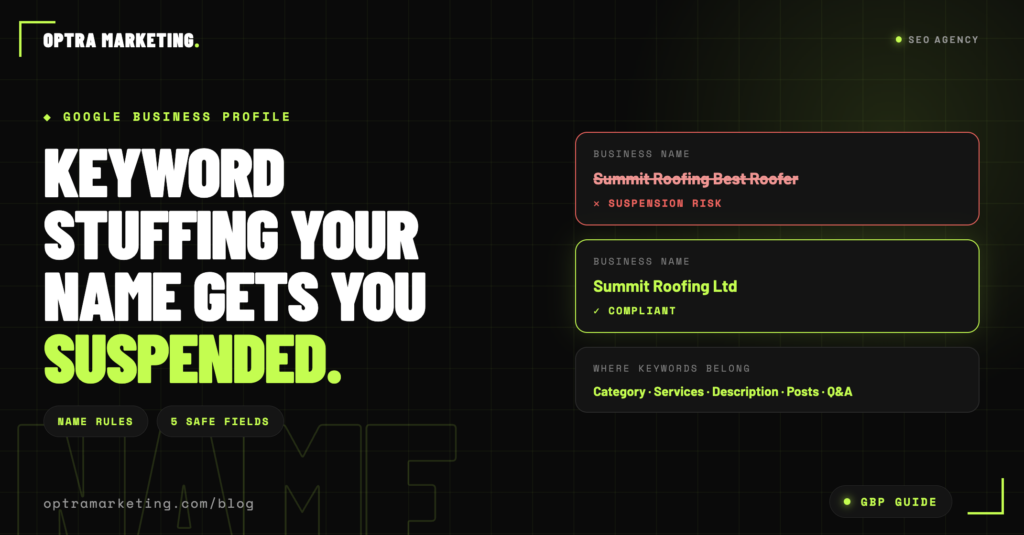
If you have searched for how to add keywords to your Google Business Profile, you have almost certainly been told to put your services and your city into your business name. “Summit Roofing” becomes “Summit Roofing – Best Roof Repair Denver 24/7 Storm Damage”. It works, briefly. Then Google catches it, or a competitor reports it, and you lose the listing that generates most of your calls.
There is a safer route. Google gives you five fields that carry real keyword weight, and the business name is not one of them. This is how to use them properly.
Why the business name is the wrong place
Google’s guidelines are explicit: your profile name must be your real-world business name, the one on your paperwork, your signage, and your website. Extra service terms, city names, taglines, and phone numbers are all treated as keyword stuffing.
Stuffed business names are the most common trigger for profile suspensions. When a suspension lands, the consequences are not proportionate to the shortcut:
- Your profile disappears from Google Search and Google Maps
- Your review history goes with it
- Reinstatement requires fixing the violation first, then filing an appeal with documentation proving the business is real
- Appeals commonly take anywhere from a few days to over a month
- Repeat violations are harder to reverse than the first
For a business that lives on inbound calls, a month of invisibility in Maps is not a ranking setback. It is a revenue event.
The counter-argument we hear on every discovery call is: “my competitors are doing it and they are ranking.” That is often true. What you cannot see is whether their profile has already been reported, or whether it will still be live next quarter. Building your visibility on a tactic that has an enforcement clock attached to it is not a strategy.
The five fields that actually carry keyword weight
1. Primary category
This is the single most influential relevance signal on your profile. Google uses your primary category to decide which searches you are even eligible for. A roofing contractor set to “Contractor” instead of “Roofing Contractor” is competing in the wrong pool entirely.
How to use it well:
- Pick the most specific category that describes your core service, not the broadest one
- Check what your top-ranking competitors use as their primary category and compare
- Change it only when your service focus genuinely changes, because frequent edits on a profile can trigger review
2. Secondary categories
You can add additional categories for the other services you genuinely provide. This is where a plumber adds “Drainage service” or “Water heater repair” without touching the business name.
Two rules keep this safe. Only add categories for services you actually deliver, and keep the list tight. A profile with fifteen loosely related categories reads as less relevant, not more.
3. Services
The services section is an underused keyword surface. You can list individual services and write a short description for each one.
This is where the specific, high-intent phrases belong. Instead of one entry for “Roofing”, list emergency roof repair, storm damage restoration, flat roof replacement, gutter installation, and so on, each with a couple of sentences that read like a human wrote them.
4. Business description
You have 750 characters. Use them to describe what you do, who you serve, and the areas you cover, in natural sentences.
Write it for a customer deciding whether to call you. Keywords should appear because they are the words your customers use, not because you are hitting a density target. A description that reads like a list of search terms converts badly even when it ranks.
5. Posts and Q&A
These are the two fields most business owners never touch, and they refresh.
Weekly Posts let you target seasonal and service-specific phrases: gutter cleaning before winter, AC servicing before summer. Q&A lets you seed the questions customers actually ask, with clear answers, using the phrasing they use. Both keep the profile active, and both give Google fresh, relevant text to associate with your business.
What to do if your business name is already stuffed
If you inherited a keyword-stuffed name from a previous agency, or added one yourself, you have a decision to make. Leaving it in place means carrying a permanent suspension risk. Removing it usually means a temporary ranking dip while Google recalibrates.
The practical sequence we use:
- Strengthen the safe fields first. Fix the primary category, build out services, rewrite the description, start posting
- Build the supporting signals: consistent name, address, and phone across your website and directories, plus a steady review flow
- Then correct the business name, once the profile has other relevance signals holding it up
- Monitor rankings for four to six weeks and keep publishing through the dip
Fixing the name first and then hoping is how businesses lose rankings twice.
A quick audit you can run today
- Does your profile name match your legal or trading name exactly, with no added services or cities?
- Is your primary category the most specific match for your core service?
- Have you listed every service individually, with descriptions?
- Is your 750-character description filled in, and does it read naturally?
- Have you posted in the last seven days?
- Are there answered questions in your Q&A section?
If you answered no to three or more, there is meaningful ranking headroom on your profile without touching a single risky tactic.
Frequently asked questions
Can I put keywords in my Google Business Profile name?
No. Google requires your profile name to match your real-world business name, the one on your paperwork, signage, and website. Adding services, city names, or taglines counts as keyword stuffing and is the most common trigger for profile suspension.
Will I definitely get suspended for a keyword-stuffed business name?
Not immediately, and that is what makes it dangerous. Enforcement can come weeks or months later, either from Google’s automated review or from a competitor reporting you. The risk does not expire, it just sits there.
Where should keywords go instead?
Five fields carry genuine weight: your primary category, secondary categories, individual service listings, the 750-character business description, and your Posts and Q&A. The primary category is the most influential of the five.
How many categories should I add?
One primary category that is as specific as possible, plus secondary categories only for services you genuinely deliver. A long list of loosely related categories makes your profile read as less relevant, not more.
How long does it take to fix a suspended Google Business Profile?
You must correct the violation before appealing, then submit a reinstatement request with documentation proving the business is real. Clean cases commonly resolve in a few days to around two weeks, though some take longer. Your profile is invisible in Search and Maps throughout.
My competitors have keyword-stuffed names and they rank. Should I copy them?
You cannot see whether their profile has already been reported or reviewed, or whether it will still be live next month. A better response is to report the violation and build your own relevance through the fields that carry no risk.
Does the business description affect rankings?
It is a relevance signal, but a modest one compared to your primary category. Write it for a customer deciding whether to call you, in natural sentences. A description written to hit a keyword density target converts badly even when it helps you rank.
How Optra Marketing can help
Google Business Profile optimisation is one of our six core pillars, and for most local service businesses it is the fastest lever available. We handle the full setup: category strategy, service build-out, description copy, weekly posts, Q&A seeding, review strategy, and geo-tagged imagery.
We do it inside Google’s guidelines, because a suspended profile costs more than a slow month of ranking gains ever saves.
If your profile is already stuffed, or already suspended, that is a conversation worth having before you make another edit. Book a free strategy call and we will tell you what we would fix first, whether or not you work with us.
