
Who Actually Needs Local SEO (and Who Doesn’t)
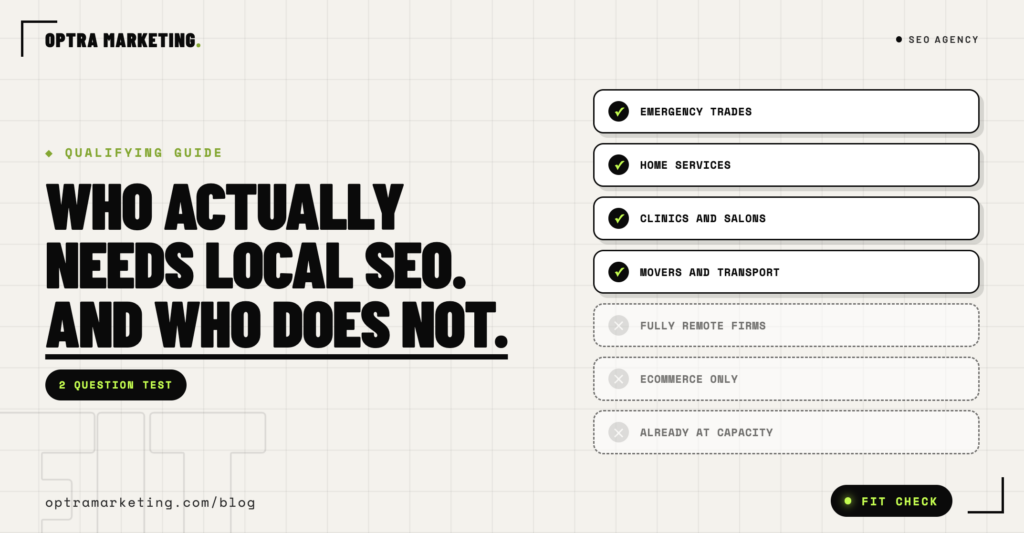
Most articles answering this question conclude that every business needs local SEO.
They are written by people selling local SEO.
The truthful answer is that it is transformative for some businesses, useful for others, and a poor use of money for a third group. Knowing which you are is worth more than another list of benefits. If you’re weighing this against paid channels specifically, why local SEO matters more than ads covers that comparison directly. For the cost and return side of this question, see is local SEO worth it.
The test that answers it quickly
Ask yourself two questions:
- Do customers find you by searching for a service plus a place, or a service plus “near me”?
- Does a phone call or an enquiry lead directly to revenue?
Two yeses and local SEO is probably the highest-return marketing channel available to you. One yes and it is likely worth doing but not as your primary channel. Two nos and your money belongs elsewhere. If it’s two yeses, start with our local SEO for beginners guide.
Businesses local SEO works best for
Emergency and urgent service trades. Plumbers, electricians, roofers, HVAC and air conditioning, locksmiths, garage door repair, water damage restoration. This is the strongest fit of all. The search happens at the moment of need, the customer picks from the top three results, and they call rather than research. There is almost no consideration phase to lose them in.
Home and property services. Cleaning and housekeeping, landscaping, painting and decorating, pest control, general contracting, flooring. Slightly longer decision cycles than emergency trades, which makes reviews and photographs of completed work do more of the closing.
Vehicle and transport services. Auto garages, mobile mechanics, tyre and repair shops, car detailing. High search volume, clear local intent, and a category where review depth is decisive because trust is the barrier.
Health and personal services. Clinics, dental practices, physiotherapy, chiropractic, salons and beauty, opticians. Proximity matters enormously here, because people choose providers near home or work. Reviews carry unusual weight given the trust involved.
Professional services with local clients. Law firms, accountants, estate and letting agents, insurance brokers, mortgage advisers. Higher value per client makes even modest ranking improvements worth a lot. More competitive and slower to rank, but the economics justify the patience.
Food, retail, and hospitality. Restaurants, cafes, bars, specialist retail. Direction requests and “open now” filtering matter as much as ranking. Photos and hours accuracy do disproportionate work.
Removals, transport, and logistics. Packers and movers, vehicle transport and car shipping, freight, storage and warehousing. This is a category we would single out. It has substantial search volume, genuine local intent, and is markedly underserved by good local SEO. Most operators in it have profiles that have never been properly configured, which means the ground available is unusually large.
Businesses local SEO works poorly for
Fully remote businesses with no local customer base. If you serve clients anywhere and location is irrelevant to the purchase, local SEO is the wrong tool. You want national or topical organic SEO instead. You may also not qualify for a Google Business Profile at all, since eligibility generally requires in-person customer interaction.
Ecommerce with no physical presence. Product SEO, marketplace optimisation, and paid channels will do more for you than local ranking work.
Businesses whose work comes entirely through contract or tender. If your revenue arrives through procurement processes, framework agreements, or long-standing commercial relationships, search visibility is not where your next contract comes from.
Businesses at capacity. If you are turning work away, more enquiries is not the problem to solve. Pricing, margin, or capacity is. Come back to this when you are ready to grow.
Businesses that cannot answer the phone. This is the most common one, and the most costly. Local SEO produces calls. If those calls go to voicemail during working hours, you are paying to send customers to your competitors, who will answer. Fix the intake process first. It is cheaper and it improves everything else you do.
The grey area: businesses that need it but are not ready
Some businesses would benefit and should still wait a month or two.
- No verified Google Business Profile. Claim and verify it first. That step is free and it is a prerequisite
- A suspended profile. Reinstatement comes before any ranking work counts
- A website that does not function on mobile. Fix the site, then drive traffic to it
- No capacity to gather reviews. Reviews are the single most accessible prominence lever a small business has. If nobody will ask for them, a large part of the potential goes unused
How to judge the return for your business
Work through this in order:
- What is your average job or client worth? Gross, then net
- What does one new customer per month add annually? For a trade with four-figure jobs, this number gets serious quickly
- How many of your competitors have properly configured profiles? Search your main service plus your town and look at the top three. If their profiles are thin, the ground is available
- Is there search volume for what you do in your area? Every category has some. Some have far more than others
- Can you handle the additional work if it lands?
If the answer to five is no, that is the thing to fix first. Once you’ve done this exercise, how long local SEO actually takes will tell you when to expect the return to show up.
Frequently asked questions
Who needs local SEO the most?
Businesses where customers search at the moment of need and call rather than research. Emergency trades such as plumbing, roofing, electrical, and HVAC sit at the top, followed by home services, vehicle services, clinics, and local professional services.
Do I need local SEO if I do not have a shop or office?
Yes, if you travel to customers. That makes you a service area business, which is a supported and common setup. You enter a real address for verification, hide it, and define the areas you serve.
Is local SEO worth it for a very small business?
Often more so than for a large one, because many local competitors have incomplete profiles. In less saturated markets the gap between a properly built profile and a neglected one is large and relatively quick to exploit.
Does local SEO work for online-only businesses?
Generally no. If there is no local customer base and no in-person interaction, you likely do not qualify for a Google Business Profile and your effort belongs in national or topical organic SEO instead.
Should I do local SEO if I already have more work than I can handle?
Not yet. More enquiries will not solve a capacity problem, and it may make service quality worse, which shows up in your reviews. Revisit when you are ready to grow.
I get all my work from referrals. Do I still need this?
Consider that referred customers often search for you before calling. A thin profile with no reviews undermines a referral at exactly the moment it should be closing. Even businesses that do not need discovery benefit from the verification role local search plays.
How do I know if my competitors are doing local SEO?
Search your main service plus your town. Look at the top three profiles: review count and recency, photograph volume, completeness of services and description, and whether they post. If those are thin, the market is winnable.
How Optra Marketing can help
We will tell you if you are not a fit. That is not a sales technique, it is that taking on a business we cannot produce results for is a bad outcome for both of us, particularly when the engagement is month to month and carries a 90-day guarantee.
Our primary focus is local service businesses that live and die by inbound calls: roofing and construction, HVAC, plumbing, electricians, cleaning, auto services, clinics and healthcare, physiotherapy, dental, salons, law firms, real estate, restaurants, and retail.
We also work deliberately in removals, vehicle transport, logistics, freight, and storage, because it is a category with real demand and very little good local SEO in it.
The free strategy call is a straight assessment: your market, your competitors, what is realistically achievable, and whether this is the right investment for you right now. If you’ve decided this is the right investment but don’t want to do it yourself, see why hire a local SEO company.
Book yours with Optra Marketing.
