
Why “Contractor SEO” Means Something Different for Every Trade
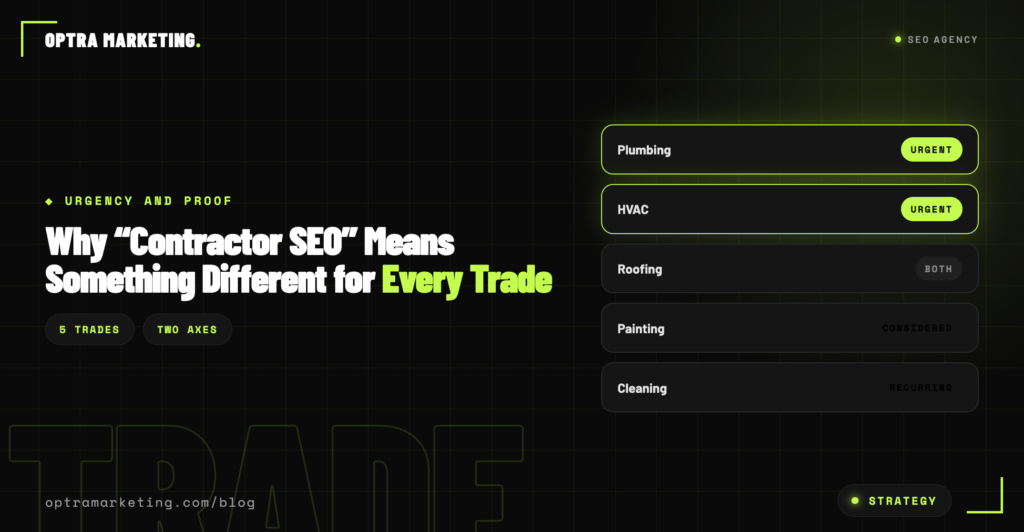
Search “contractor SEO” and you will find a lot of advice written as if every trade behaves the same way in search. It does not. A plumber and a painter are answering completely different questions for completely different buying decisions, and a strategy built for one tends to underperform when copied onto the other.
Understanding what actually differs by trade matters more than any generic checklist, because it determines what to prioritise first.
How Urgency Changes SEO Strategy by Trade
Some trades sell into an emergency. A burst pipe, a broken furnace in winter, a roof leaking during a storm: these searches happen in the moment, and the decision is made in minutes, not days.
For plumbing and HVAC, local SEO has to prioritise speed of information: a Google Business Profile that answers “are they open now” instantly, a website that loads fast on a phone, and a map pack presence that puts the business in front of someone who will call whoever appears first and looks credible.
Painting is rarely an emergency. The decision takes longer, and local SEO for a painting contractor has to do more persuading along the way: real photos, detailed reviews, a portfolio that builds confidence over days rather than minutes.
Roofing sits in between. Storm damage creates genuine urgency, while a planned re-roof runs on a slower, more considered version of roofing local SEO. A roofing business that only builds for one half of that split leaves real demand on the table during the other half of the year.
Cleaning adds a third pattern: recurring purchase rather than one-off. Someone hiring a cleaning service is evaluating an ongoing relationship, which shifts local SEO for cleaning businesses toward retention signals as much as acquisition ones.
What Proof Means for Different Trades
For emergency trades, proof is about reliability: reviews mentioning fast response, fair pricing, and the job done properly first time. For visual trades like painting, proof is photographic: the finished work needs to speak for itself, which puts far more weight on gallery quality and organisation.
This is why a checklist that works well for one trade can quietly fail another even when every item is technically completed. A roofing company with beautiful photos and a slow review response habit has the balance backwards. A painting business with fast phone response and a thin gallery has the same problem in reverse.
Search Competition Varies by Trade More Than People Expect
Some trades face heavy competition because the market is saturated with providers targeting the same handful of terms. Others sit in the opposite position: real search demand with very few businesses doing local SEO properly at all.
A saturated trade rewards depth and differentiation: more detailed pages, a stronger review system, better photography than the next competitor. An underserved trade rewards simply showing up properly, since the bar being cleared is often just “does this business have an accurate, complete online presence.”
Painting and general contracting more often fall into the second category than plumbing or HVAC, where competition for the obvious terms is usually fiercer.
What Stays the Same Across Every Trade
Despite these differences, a handful of fundamentals hold regardless of trade: an accurate, fully completed Google Business Profile, consistent business information across every directory, a fast and mobile-friendly website, and a genuine system for collecting and responding to reviews.
These are the foundation underneath every trade-specific strategy. They just get weighted differently depending on how urgent the buying decision is and how much proof a photo can carry compared to a review.
Frequently Asked Questions About Trade-Specific SEO
Is there one contractor SEO strategy that works for every trade?
The foundational pieces are shared: profile accuracy, citations, reviews, and site speed. The priority order and the type of proof that convinces a buyer differ enough by trade that a fully generic strategy consistently underperforms one built around how that trade is actually bought.
Which trades benefit most from fast websites and profiles?
Emergency and near-emergency trades: plumbing, electrical, HVAC, and storm-related roofing. The decision happens in minutes, so a slow-loading page or an ambiguous “open now” status loses the call before any other ranking factor gets a chance to matter.
Which trades rely most on photos and detailed reviews?
Visual, considered-purchase trades: painting, planned roofing, and renovation work. The buyer compares options over days or weeks, so portfolio depth and review specificity do more work than speed of response ever will.
How should a multi-trade contractor approach SEO?
By building trade-specific content and pages rather than one undifferentiated strategy. Multi-trade contractors face this challenge more acutely than anyone, since they need both the urgency playbook and the proof playbook operating inside one business.
Does trade competitiveness change how much SEO costs?
Yes, more than business size does. Competing in a saturated trade in a large metro requires sustained content and link work. An underserved trade in a smaller market can often reach a strong position with foundational work alone, at considerably lower ongoing cost.
Which contractor trades are easiest to rank for?
Generally those where fewer competitors have built proper local SEO: painting, general contracting, and several specialist trades. Easiest does not mean most valuable, though, since ranking well in a small-demand trade still caps out at whatever the market supports.
Do emergency trades need blog content at all?
Less than considered-purchase trades. Emergency trades get more from a complete profile, fast site, and strong map pack presence. A handful of useful posts still helps, but content volume rarely outperforms profile quality for a business people call in a crisis.
How do I know which category my trade falls into?
Ask how fast your customer decides and what convinces them. Minutes and reliability puts you in the emergency group. Weeks and visual proof puts you in the considered group. Many trades sit across both, and need building for each separately.
Two Questions Worth Answering First
Before any strategy makes sense for your trade, answer these honestly.
How fast does your customer decide? If it is minutes, speed and profile completeness beat everything else. If it is weeks, proof and portfolio matter more than shaving a second off page load.
What convinces them? For some trades it is a photograph. For others it is a review saying someone showed up when they said they would. Building the wrong one first is the most common way contractors waste a year of SEO spend.
We answer both before proposing anything, because the answers differ by trade and by market, and a strategy that ignores them is guesswork with a report attached. Month to month, no lock-in, rankings improve within 90 days or we keep working free.
Book a free strategy call and we will place your trade on both of those axes.
