
Local SEO for Movers and Packing Companies: An Underserved Market
Moving is one of the few local services where almost everyone searching is a guaranteed customer for someone. Nobody researches removal companies out of curiosity. If they are searching, they are moving, and within a few weeks they will have paid someone.
What makes this market unusual is that demand is high and search competition is often surprisingly weak. Plenty of removal firms rely almost entirely on directory listings and quote comparison sites, which leaves the organic space thinner than in trades like plumbing or roofing.
Why the Moving Booking Window Changes SEO Strategy
Someone needing an emergency plumber decides in minutes. Someone moving house typically starts looking four to eight weeks ahead, gathers three or four quotes, and takes days to decide.
That long window is an advantage if content is built for it. A firm that exists only as a phone number and a quote form competes on price alone. A firm with genuinely useful content about how quotes are calculated, what affects cost, and what packing services include gets found earlier in that window and shapes how the customer evaluates everyone else.
Route Pages: The Biggest Missed Opportunity in Removals SEO
This is the structural quirk of the industry. A plumber serves a radius. A removals firm serves a route, and the two endpoints are often in completely different places.
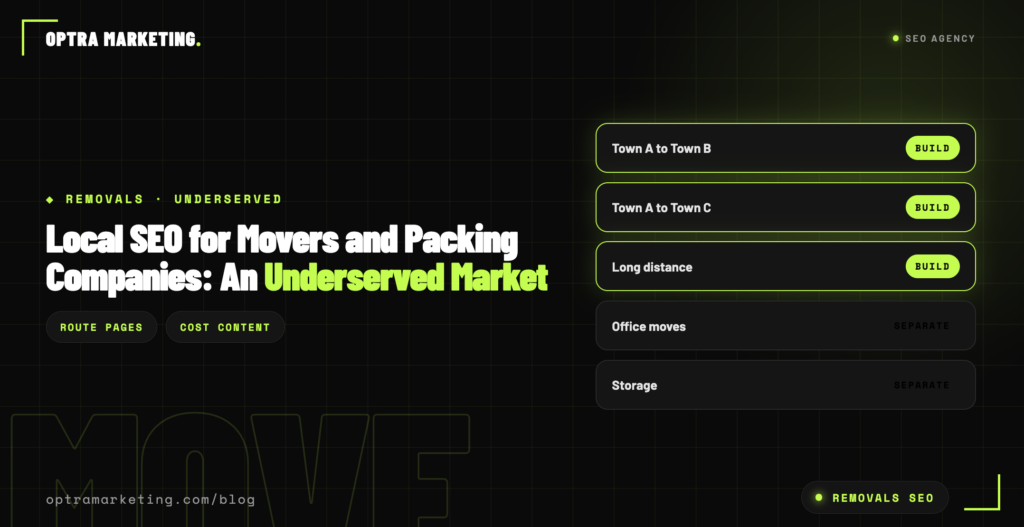
Most removal company websites are built around where the business is based. The searches, though, are frequently built around where the customer is moving from and to. Someone searching “removals from [town A] to [town B]” is a high-intent, low-competition search almost nobody builds pages for.
Long-distance and interstate moves in particular deserve their own content, since they carry higher values and the customer often looks well beyond their immediate area. This makes removals one of the clearest cases for ranking across multiple locations, though the structure differs: here it is routes and destination towns that need pages, not offices.
Separating Service Types on a Removals Website
Removal firms typically list everything on one page: house moves, office moves, packing, storage, piano and specialist items, international. Each is a different search with a different customer.
Office and commercial moves are a distinct buyer entirely, usually an office manager working to a deadline, with different concerns around insurance, out-of-hours working, and minimal disruption. A page written for a homeowner does not speak to them at all.
Storage is worth separating too, since it is often searched independently and brings in customers who did not arrive looking for a mover.
Trust Signals That Convert Removal Enquiries
A customer is handing over every possession they own to strangers. The anxiety level is high, and what resolves it is specific: insurance details clearly stated, membership of relevant trade associations, real photographs of the actual vans and crew rather than stock imagery, and reviews mentioning care, punctuality, and nothing being damaged.
A consistent system for collecting reviews is worth more here than in trades where the customer is less exposed. Timing helps too: a removal customer is at their most relieved on the day the job finishes, and an ask arriving a week later converts noticeably worse.
Moving Cost Content: Highly Searched, Rarely Answered
“How much do removals cost” and its variations are among the highest-volume searches in the industry, and most removal firms refuse to address them at all, on the reasoning that every move is different.
That reasoning is correct and the conclusion is still wrong. A page explaining how quotes are calculated, what drives cost up or down, volume, distance, access, stairs, packing, timing, and what a typical range looks like, answers the search without committing to a number. It also teaches the customer how to compare quotes, which favours the firm that explained it.
Planning Around Moving Season
Moving demand is heavily seasonal in most markets, with summer months and month-ends carrying disproportionate volume. Content published in the quiet season has time to index and mature before the peak arrives, which means the work needs doing several months before demand shows up.
Firms starting SEO in the middle of peak season are usually too late to benefit that year.
Frequently Asked Questions About Moving Company SEO
Why is search competition weaker for removals than other trades?
A large share of the industry leans on comparison sites and directories for leads rather than building organic visibility. That leaves the organic space considerably less contested than the underlying search demand would suggest, which makes it one of the more winnable local markets for a firm willing to build proper content. That makes it one of the more winnable local markets for a firm willing to build proper content.
Should a removals firm build pages around routes or its base location?
Both, but route pages are the genuinely underused opportunity. Almost nobody builds them, the searches carry very high intent because the customer has already decided both endpoints, and they face minimal competition in most markets. Base location pages matter too, they are just far more contested. Base location pages matter too, they are simply far more contested by every other firm nearby.
Do quote comparison sites help or hurt moving companies?
They generate volume but usually at low margin and in direct price competition with three other firms quoting the same job. Organic visibility tends to produce better-qualified enquiries because the customer arrived at you specifically rather than submitting a form to whoever responds fastest and cheapest. Most firms use them to fill gaps rather than as the foundation of the business.
When should a moving company start SEO work?
Well before peak season. Content and rankings take months to mature, so work started during the quiet winter period is what actually pays off when summer demand arrives and everyone is too busy to market. Starting mid-season means missing that year’s peak almost entirely. Starting mid-season generally means missing that year’s peak almost entirely.
Should movers publish pricing information?
Publish how pricing works rather than fixed numbers. Explaining the factors, volume, distance, access, stairs, packing, and timing, and giving typical ranges answers the search, filters unrealistic enquiries, and positions you as the firm that was straight with them. It also teaches customers how to compare quotes, which favours you. It also teaches customers how to compare quotes, which quietly favours the firm that explained it.
How do removal companies get more reviews?
Ask on completion day, while relief is highest, rather than a week later once unpacking stress has set in. Reviews mentioning careful handling, punctuality, and nothing being damaged convert better than generic ratings for a service this anxiety-heavy, since they address exactly what the next customer is worried about. The ask on completion day consistently outperforms one sent a week later.
Do moving companies need separate pages for commercial moves?
Yes, if commercial work is something you want. The buyer is an office manager rather than a homeowner, the concerns are insurance, out-of-hours working, and minimal disruption, and the decision process is entirely different. Homeowner-facing content rarely produces office relocation enquiries no matter how well it ranks. Homeowner-facing content rarely produces office relocation enquiries no matter how well it ranks.
How many route pages should a removals firm build?
Only for routes you genuinely run regularly and can write specifically about. A dozen real routes with genuine detail outperform fifty templated pages, which risk being treated as thin content and rarely rank at all. Build them as the work justifies rather than listing every theoretical combination. Build them as the work justifies rather than listing every theoretical combination.
The Route Pages Nobody Builds
If there is one thing worth taking from this, it is the route-based pages. Most removal firms have never built a single one, while the searches happen constantly and convert unusually well because the customer has already decided both ends of their move.
It is not a large amount of work to build them for the routes you actually run regularly, and it is close to uncontested ground in most markets. Route pages are a content strategy decision more than a technical one.
That is usually where we start with removal companies, alongside separating out the commercial and storage sides that get buried on a single services page. Month to month, no lock-in, and rankings improve within 90 days or we keep working for free.
Book a free strategy call and we will map out which routes are worth building for.
