
The Complete Local SEO Checklist for Roofing Contractors in 2026
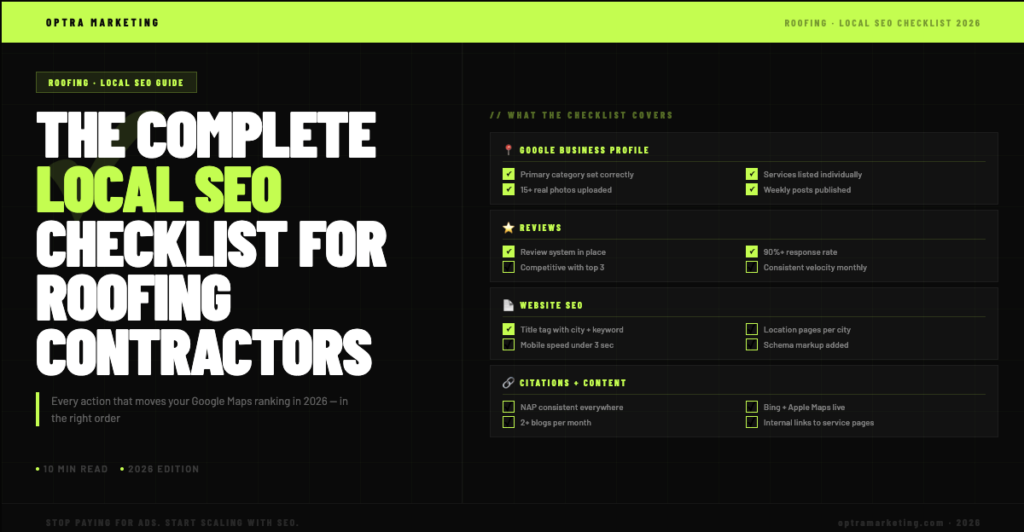
Most roofing contractors know they need to do something about SEO. Very few know exactly what that something is or in what order to do it.
This is the complete checklist. Every item on this list is something that directly impacts your ability to rank on Google Maps and appear in local search results when homeowners in your city are searching for a roofer right now.
Work through it in order. The items at the top of each section have the highest impact and should be prioritised first.
Section 1: Google Business Profile Checklist
Your Google Business Profile is the foundation of your local SEO. Every item on this list matters.
Primary category set to Roofing Contractor : This is the single most important GBP setting. Your primary category directly determines which searches you appear for. If it says anything other than Roofing Contractor change it before doing anything else.
Secondary categories added : Add relevant secondary categories for the services you offer. Roof Repair Service, Commercial Roofing Contractor, and Metal Roofing Contractor are all valid secondary categories depending on your service mix.
Business description written with primary keywords : Your GBP description should include the phrase roofing contractor, your primary city, and two or three of your core services. Keep it under 750 characters and write it for a homeowner not for Google.
All services listed individually with descriptions : Do not just list Roofing. Break it down. Roof Installation. Roof Repair. Storm Damage Repair. Emergency Roofing. Flat Roof Installation. Commercial Roofing. Each service listed individually gives Google more signals to match your GBP against specific search queries.
Minimum 15 photos of real completed work : Real job photos. Not stock images. Before and after shots from actual projects in your market. Photos of your team, your vehicles, and your signage. A completed GBP with strong photos consistently outperforms one without.
Weekly posts published : Post at least once per week. Rotate between completed job showcases, seasonal tips, limited time offers, and review highlights. Consistent posting signals to Google that your business is actively operating.
Questions and answers section populated : Add your own questions and answers to the Q and A section. This is underused by almost every roofing contractor and it gives you the ability to proactively answer the questions homeowners are most likely to ask.
Booking link or website link verified and working : Check that every link on your GBP goes to the right place and loads correctly. A broken link is both a user experience failure and a trust signal problem.
Section 2: Google Reviews Checklist
Reviews are one of the three most powerful ranking signals on Google Maps. Every item here matters.
Review generation system in place : You need a consistent, repeatable process for collecting reviews after every completed job. The most effective method is a text message sent within 24 hours of completion with your direct Google review link. Not an email. A text.
Response rate above 90 percent : Respond to every review. Positive and negative. A business that responds to reviews signals to Google that it is actively engaged with customers. A business that does not respond looks less trustworthy to both Google and potential customers.
Negative reviews handled professionally : Every unanswered negative review is a missed opportunity to demonstrate professionalism to every homeowner who reads it. Respond calmly. Acknowledge the concern. Offer to resolve it offline. Never argue publicly.
Review count competitive with top-ranking competitors : Search for the top three roofing contractors on Google Maps in your primary city right now. Count their reviews. That is your competitive benchmark. Your goal is to meet and then surpass that number through consistent monthly review generation.
Review velocity consistent month over month : Getting 50 reviews in one month and then nothing for six months actually weakens your signals. Google values recency. Three to five new reviews per month consistently is significantly more valuable than a one-time spike.
For the complete strategy on building a review system that works see our guide on how to get more Google reviews for your business.
Section 3: Website and On-Page SEO Checklist
Homepage title tag includes primary keyword and city : Format: Roofing Contractor [City] | [Service] | [Company Name]. Keep it under 60 characters. Include the most important keyword first.
Homepage meta description written for click-through rate : Under 160 characters. Include your primary keyword and a clear reason to click. A specific offer like Free Roof Inspection or 90 Day Guarantee included in the meta description consistently improves CTR.
H1 tag contains primary keyword : One H1 per page. It should contain your primary keyword and match the intent of the search you are targeting on that page.
Location pages built for every city you serve : One page per city. Each page needs unique content specific to that market. Not a copy-paste of your homepage with the city name changed. Unique content, local references, and a specific CTA targeting that area’s homeowners.
NAP consistent with Google Business Profile : Your business name, address, and phone number on your website must be identical to what is on your GBP. Even small differences create conflicting signals that hurt your local rankings.
Mobile load speed under three seconds : Most roofing searches happen on mobile. Run your website through Google PageSpeed Insights right now. If your mobile score is below 70 or your LCP is above 2.5 seconds your rankings are being limited by speed.
Internal linking connecting blogs to service pages : Every roofing blog post you publish should include at least one contextual internal link back to your main roofing SEO service page. This passes authority from your blog content to the page you most want to rank.
Schema markup implemented : At minimum you need LocalBusiness schema on your homepage and Service schema on your service pages. FAQ schema on pages with questions and answers. These help Google understand your content and can generate rich results in search.
Section 4: Local Citations Checklist
Google Business Profile claimed and verified : If your GBP is not verified it will not rank. Verification is the first step and it is non-negotiable.
Bing Places listing created and consistent : Many roofing contractors completely ignore Bing. Bing Places is free to set up and drives meaningful traffic in markets where Bing usage is higher.
Apple Maps listing created : Apple Maps is the default search tool on iPhones. A significant portion of homeowners searching for roofers on their phone are using Apple Maps without knowing it.
Yelp listing claimed and complete : Even if you do not actively use Yelp your listing exists. Unclaimed listings often have incorrect information that conflicts with your GBP and hurts your local consistency.
Angi and HomeAdvisor profiles complete : These platforms are also citation sources. Even if you do not pay for their lead generation services having a complete and accurate profile on both platforms adds to your citation authority.
Industry specific directories covered : The Better Business Bureau, Houzz, and the National Roofing Contractors Association directory are all relevant citation sources for roofing contractors. A presence on each adds to your overall citation authority.
NAP identical across all listings : Use the exact same format for your business name, address, and phone number everywhere. Run a citation audit at least once per quarter to catch any inconsistencies that have crept in.
Section 5: Content Strategy Checklist
Primary roofing service pages published and optimised : Roof Installation. Roof Repair. Emergency Roofing. Storm Damage Repair. Commercial Roofing. Each of these should be a separate, dedicated page with unique content and its own keyword targeting.
Monthly blog posts published consistently : A minimum of two roofing-focused blog posts per month. Topics should target the questions your ideal customers are actually searching. What homeowners want to know about roof replacement cost, how to find storm damage, what to expect during a roof installation.
Blog posts internally linked to service pages : Every blog post should include at least one link to a relevant service page. This creates a content cluster that passes authority from your informational content to your conversion pages.
Competitor content gaps identified : Use a tool like Ahrefs to find keywords your competitors are ranking for that you are not. These gaps represent opportunities to create content that captures searches your competitors are currently winning.
FAQ content targeting common homeowner questions : What does a new roof cost in my city. How long does roof replacement take. Does homeowners insurance cover roof damage. These are questions homeowners search for before they are ready to hire. Answering them builds trust and captures early-stage traffic.
How to Use This Checklist
Work through it section by section. Mark each item as complete, in progress, or not started. Prioritise the GBP section first because it has the highest impact on Google Maps rankings. Then tackle reviews and website on-page simultaneously. Citations and content are ongoing rather than one-time tasks.
Most roofing contractors who work through this checklist systematically start seeing Google Maps ranking movement within 60 to 90 days. The results compound from there as each element reinforces the others.
If you want to go through this checklist alongside an expert who has done this for roofing contractors specifically our local SEO for roofing companies service covers every item above plus the ongoing execution of each one every month.
We have taken roofing contractors from zero visibility to top 3 on Google Maps in competitive markets using exactly this framework. No shortcuts. Just the right fundamentals executed consistently.
