How to Rank Your Business on Google Maps in 2026
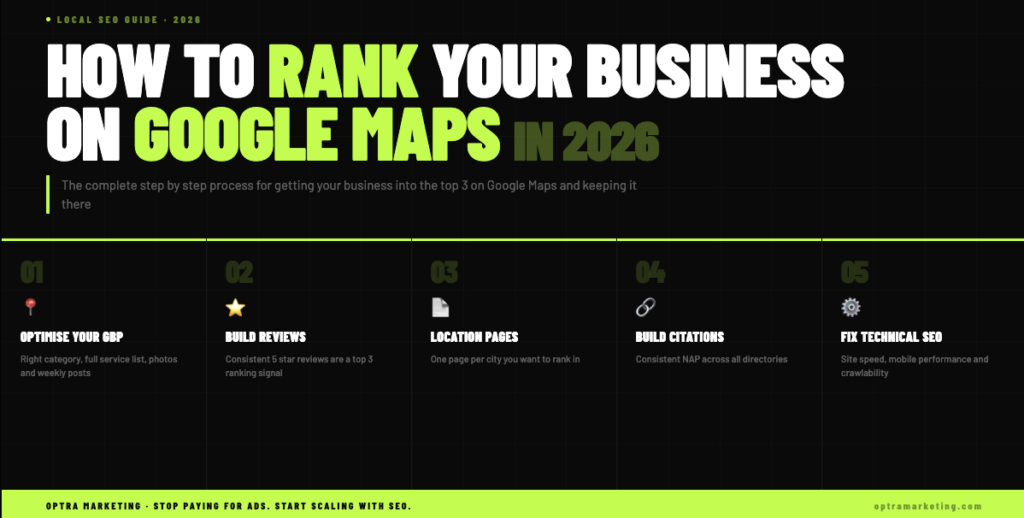
Every local business owner wants to appear in the top three results on Google Maps. Those three spots capture the majority of clicks, calls, and bookings for almost every local search. The businesses sitting below them get almost nothing.
Ranking there is not complicated. But it does require getting a specific set of things right in the right order. This is the complete breakdown of what actually moves the needle in 2026.
Why Google Maps Rankings Matter More Than Ever
When someone searches for a local service on their phone, the first thing they see is the map. Three businesses. Star ratings. Distance. A call button. Most people call one of those three and never scroll further.
46 percent of all Google searches have local intent, meaning the person searching wants something near them right now. If your business is not in the top three for those searches you are invisible at the exact moment someone is ready to spend money.
Step 1: Get Your Google Business Profile Right
Your Google Business Profile is the single most important factor in your Google Maps ranking. Everything starts here.
The most common and most damaging mistake is having the wrong primary category. Google uses your primary category to determine which searches you should appear for. If it does not match your core service accurately you will not rank for the searches that matter.
Beyond the category your profile needs to be fully complete. Business description written with your primary keywords included naturally. All services listed individually with descriptions. A minimum of 10 high quality photos of your actual work, team, and premises. Weekly posts showing Google that your business is active.
Most businesses set up their profile once and never touch it again. The businesses ranking at the top of maps in your city are actively managing their profile every week. That activity is a ranking signal and your Google Business Profile directly impacts how high you appear.
Step 2: Build Google Reviews Consistently
Reviews are one of the three most powerful ranking signals on Google Maps. Not just the number of reviews you have. The recency of them. The rating. And whether you respond to them.
A business with 60 recent reviews will almost always outrank a business with 15 reviews even if every other signal is equal. And a business getting three to five new reviews every month signals to Google that it is consistently delivering good service.
The most effective review collection system is the simplest. Send a text message with your direct Google review link within 24 hours of completing every job. Every job. No exceptions. Over time this creates a compounding advantage that competitors who are not doing it cannot catch up to quickly.
Step 3: Build Location Specific Pages on Your Website
A single homepage cannot rank in multiple cities. If you serve five cities but only have one homepage you are invisible in four of them.
Every city you want to rank in needs its own dedicated landing page. Each page needs to be genuinely unique with content specific to that location. The page needs to mention the city naturally throughout, cover the services you offer there specifically, and include local signals that tell Google this page is relevant to searches in that area.
This is one of the most consistently underutilised tactics in local SEO and one of the highest impact things you can do if you want to rank across multiple service areas.
Step 4: Build Local Citations
A local citation is any mention of your business name, address, and phone number on another website. Google uses citations to verify that your business is legitimate and properly located.
The most important thing about citations is consistency. Your business name, address, and phone number need to be identical across every listing. Even small differences like Street versus St or a missing suite number can dilute the trust signals your citations are supposed to build.
Start with the major directories. Google Business Profile, Bing Places, Apple Maps, Yelp, and Facebook. Then add industry specific directories relevant to your business type. Clean up any inconsistencies you find across existing listings before building new ones.
Step 5: Fix the Technical Issues Holding You Back
Most local business websites have technical issues that quietly limit their rankings. The most damaging and most common is slow mobile load speed.
Most local searches happen on mobile. If your website takes more than three seconds to load on a phone you are losing potential customers before they ever read a word. Google also uses page speed as a ranking factor which means a slow site ranks lower than a fast one regardless of how well optimised everything else is.
Run your website through Google PageSpeed Insights. Fix whatever it flags. Focus on image compression, unused plugin removal, and hosting speed. These fixes are usually faster and cheaper than most business owners expect and the ranking impact can be significant.
How Long Does This Take
Most businesses start seeing Google Maps ranking movement within 60 to 90 days of implementing these steps consistently. The full compounding effect builds over 6 to 12 months as your reviews grow, your location pages gain authority, and your citation profile strengthens.
The businesses ranking at the top of Google Maps in your city right now are not there because they got lucky. They are there because they got these fundamentals right and stayed consistent with them. That is the only sustainable path to Google Maps dominance.
If you want to know exactly where your business stands right now and what specific gaps are holding you back, we offer a free local SEO audit that covers every element on this list.