
Why E-E-A-T Matters More Than Ever in the AI Era
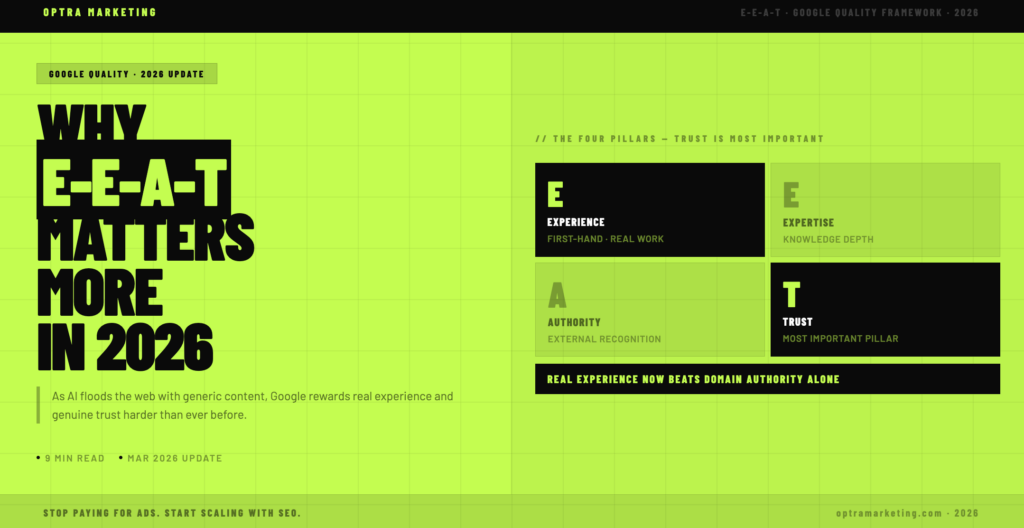
E-E-A-T stands for Experience, Expertise, Authoritativeness, and Trustworthiness. It is the framework Google uses to judge whether content is genuinely worth showing people. In an era where AI can generate an article in seconds, E-E-A-T in the AI era has quietly become one of the most important things separating businesses that rank from businesses that disappear.
Here is what it actually means and why it matters more now than it ever has.
First, What E-E-A-T Is Not
If you are asking what is E-E-A-T, start by clearing up the most common misconception: that it is a score Google assigns your site. It is not. Google does not assign an E-E-A-T score to pages or sites. Instead, E-E-A-T functions as a quality framework that helps interpret underlying signals such as content accuracy, author credibility, links, and reputation. Those signals collectively influence rankings. Keywords Everywhere
In other words, Google’s experience, expertise, authority, and trust model is the lens through which its human quality raters, and by extension its algorithms, decide whether your content feels real and trustworthy or manufactured and hollow. The quality rater guidelines that train those evaluators have leaned on this idea for years, but its weight has shifted sharply.
Why AI Made E-E-A-T More Important, Not Less
The flood of AI-generated content is exactly why this framework now carries more weight. AI has lowered the barrier to publishing, but it has also raised the bar for trust. It is now easy to create content that looks convincing without being grounded in real experience. Google anticipated this and has become sharper at filtering out pages that feel manufactured.
This came into sharp focus with recent core updates. The March 2026 update’s most visible effect was a rebalancing that elevated Experience signals relative to traditional authority indicators like link equity and topical coverage. Sites with high domain authority but thin experiential content lost ground to lower-authority sites that demonstrated genuine first-hand engagement.
Read that again, because it is the whole story in one sentence. Smaller businesses that show real, first-hand experience are now beating bigger sites that publish generic, experience-free content. That is a genuine opportunity for an honest local business. The playing field of E-E-A-T 2026 rewards the operator who has actually done the work, not just the brand with the biggest backlink profile.
The Critical Point About AI Content
There is a myth that Google penalises content just for being made with AI. That is not what is happening. The March 2026 update did not introduce an AI content penalty. Sites using AI to generate topic overviews and produce generic explanations were penalised because that content lacked experience signals, not because an AI produced it.
The content that survives and thrives shares a specific structure: it is grounded in genuine experience that a human contributor owns. The AI handles expansion, formatting, and structural clarity, while the human contributor provides the experiential specifics that cannot be fabricated.
So AI as a writing assistant is fine. AI as a replacement for real expertise is what gets demoted. The practical test is simple: if a piece of content could have been written by someone who never did the job, it carries no experience signal. The consequences of getting this wrong for local businesses are covered in depth in why AI written blogs are hurting your local rankings.
Trust Is the Most Important Pillar
Of the four pillars, one stands above the rest. Trust is the most important E-E-A-T pillar. Google’s official people-first content page states: “Of these aspects, trust is most important.”
For a local business, trust is built through unglamorous, concrete things: a real business name, address, and phone number that match everywhere online, genuine customer reviews, named authors with real credentials where relevant, transparent information about who you are, and accurate, up-to-date content. None of these are clever tactics. They are simply proof that a real, accountable business stands behind the page.
These are the same trust signals that power local SEO, which is why getting your reviews right, covered fully in how to get more Google reviews for your business, does double duty for both rankings and trust.
Where Scrutiny Is Highest
If your business touches health, money, or major life decisions, the bar is higher. Health, finance, legal, and home services categories experienced the most volatility, and Google’s quality raters apply the highest E-E-A-T scrutiny to content that could affect users’ wellbeing or financial decisions. These are what Google calls YMYL, or Your Money or Your Life, topics.
Notice that home services is on that list. If you run a roofing, plumbing, cleaning, or similar business, demonstrating real experience and trust on your website is not optional. It is a ranking requirement, and it is the difference between a page that holds through the next core update and one that quietly slips.
What To Actually Do
You do not need to chase a score that does not exist. You need to make your real experience visible. Strong E-E-A-T for business websites comes down to a handful of consistent habits. Put named people behind your content where relevant. Show genuine project examples and results. Keep your business information consistent everywhere. Collect and display real reviews. Cite credible sources. Keep your most important pages current. Add the first-hand detail that only someone who did the work would know: the specific problem, the decision, the outcome. Photos of your own jobs, named team members, and dates all reinforce that a real operator stands behind the words.
A useful habit is to audit one page a week. Ask whether it contains anything that exists nowhere else online. If the answer is no, it is a generic page, and generic is exactly what the latest updates demote. Rewrite it around something only you can say.
E-E-A-T is, at its core, Google’s attempt to reward businesses that are genuinely good at what they do and honest about it. In a web increasingly full of generic AI filler, being demonstrably real is becoming the strongest competitive advantage you have. That advantage compounds: every piece of authentic, helpful content makes the next one easier to trust.
How Optra Marketing Can Help
Every engagement at Optra is built around making your genuine expertise and real results visible to both Google and the people searching for what you offer. We do not produce generic content and call it SEO. We work from your actual case studies, your actual service area knowledge, and your actual business differentiators.
The local SEO checklist for small businesses is a good starting point for understanding all the signals that feed your E-E-A-T profile in local search. And a free audit will show you specifically which signals are strong, which are weak, and which one to build first for the fastest impact on your rankings.
