
The Complete Local SEO Checklist for Small Businesses
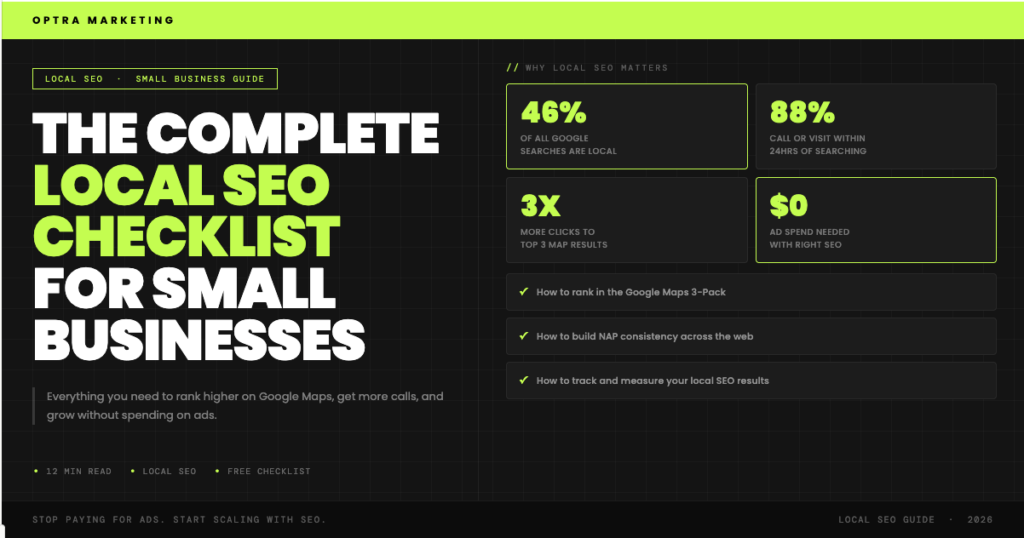
Most small businesses are invisible on Google.
Not because they have a bad product. Not because they are in a competitive market. But because nobody ever handed them a clear, honest checklist of exactly what needs to be done to rank locally.
This is that checklist.
Everything in this guide is based on what we actually do when we take on a new local business client. The same process that helped a cleaning business go from a few calls a week to $140,000 per month. The same foundation that took a roofing contractor from $20,000 to $100,000 per month in five months. No theory. No generic advice. Just the actual steps, in the right order.
Work through this from top to bottom and you will have built a stronger local SEO foundation than most of your competitors.
Why Local SEO Is Non Negotiable for Small Businesses
Before getting into the checklist, here is why this matters.
46% of all Google searches have local intent. That means nearly half of everyone searching on Google right now is looking for something near them. A service, a shop, a clinic, a contractor. Someone who can solve their problem in their area.
88% of people who search locally either call or visit a business within 24 hours. These are not browsers. These are buyers.
And the overwhelming majority of those clicks go to the top three results on Google Maps, also known as the local three pack. If your business is not in those three spots, you are missing the majority of that traffic every single day.
Local SEO is how you get there. And unlike paid ads, once you build this foundation it keeps working without you spending on every single click.
Section 1: Google Business Profile Checklist
Your Google Business Profile is the single most important asset in your local SEO strategy. It is what controls how you appear on Google Maps and in local search results. Most small businesses either have not claimed theirs or have left it half empty. Both situations cost you leads every day.
Claim and verify your profile
Go to business.google.com and search for your business. If it exists, claim it. If it does not, create it from scratch. Google will verify you through a postcard, phone call, or email depending on your business type. Do not skip this step. An unverified profile has significantly less visibility than a verified one.
Choose the right primary category
This is the single most important field on your entire profile. Your primary category tells Google exactly what type of business you are and determines which searches you are eligible to appear for.
Choose the most specific category that accurately describes your core service. If you are a physiotherapy clinic, do not choose Healthcare or Medical. Choose Physical Therapist. If you are a roofing contractor, choose Roofing Contractor, not General Contractor.
Getting this wrong is the most common mistake we see on first audits. Fixing it alone has moved businesses into the top three on Google Maps within weeks.
Add secondary categories
Add secondary categories for every additional service you offer. More categories mean more searches you qualify to appear for.
Complete every single field
Business name, address, phone number, website, hours, special hours for holidays, business description, opening date. Every field you leave empty is a signal of an incomplete listing.
Write a keyword rich business description
You have 750 characters. Use them. Write a clear, natural description of what you do, where you operate, and what makes your business the right choice. Include your primary keyword and your city naturally within the text. Write for a human first and Google second.
Add every service you offer
The services section is where most small businesses leave significant opportunity on the table. Add every single service with a name and a description. The more specific you are, the more searches you become eligible to appear for.
Upload a minimum of 20 photos
Businesses with more photos consistently receive more clicks and calls than businesses with fewer. Upload before and after photos if you do a physical service. Photos of your team. Your workspace. Completed jobs. Make them high quality and update them regularly.
Post at least once every week
Google Business Profile posts are one of the most underused tools available. Businesses that post consistently outrank businesses that do not. Rotate between offers, completed job showcases, tips, and seasonal content. Each post should include a clear call to action.
Add your products and services with prices where applicable
The products section gives potential customers more reasons to choose you before they even visit your website.
Section 2: Google Reviews Checklist
Reviews are one of the three most powerful ranking factors for Google Maps. The number of reviews you have, how recent they are, and your overall rating all directly impact where you appear.
Audit your current review count
Search for your top three competitors on Google Maps right now. Count their reviews. That gap between their count and yours is directly affecting your rankings.
Get your direct Google review link
Go to your Google Business Profile dashboard, click Share Profile, and copy the direct review link. Save it somewhere you can access instantly.
Build a review request into every completed job
The most effective method is a direct text message sent immediately after you complete a job or deliver your service. Keep it short, personal, and include the direct link. Something like:
“Hi [Name], thank you so much for choosing us. If you have a spare minute, a quick Google review would mean a lot. Here is the link: [direct link]. Thank you.”
Set a monthly review target
Look at your top competitor’s review count. Set a target that closes the gap within six months. Two to three reviews per month consistently beats a one off push of twenty reviews followed by nothing.
Create a QR code for your review page
A QR code linking directly to your review page removes all friction. Add it to invoices, receipts, business cards, and any physical materials you give customers.
Respond to every single review
Every positive review and every negative one. Responding to positive reviews builds rapport. Responding professionally to negative reviews shows potential customers that you take your service seriously. Both send positive signals to Google.
Never incentivise reviews
Offering anything in exchange for a review violates Google’s policies and can result in your reviews being removed and your profile penalised.
Section 3: On Page SEO Checklist
Your Google Business Profile gets you into the map pack. Your website supports everything else and helps you rank in the organic results below the map.
Optimise your homepage title tag
Your title tag should include your primary keyword and your location. Something like: Cleaning Service in [City] | [Business Name]. This is one of the strongest signals you can send to Google about what you do and where you do it.
Write a click worthy meta description
Your meta description drives clicks from search results. Write it like an ad. Include a benefit and a clear call to action within 160 characters.
Include your primary keyword in your H1
Your H1 heading should include your primary keyword and location naturally. One H1 per page. No exceptions.
Create a dedicated page for every service you offer
This is one of the biggest missed opportunities on small business websites. If you offer five different services, you need five dedicated pages. Not one services page listing all of them.
Google ranks individual pages, not entire websites. A dedicated page optimised for a specific service will outrank a generic page trying to cover everything.
Create location specific pages for every area you serve
If you serve more than one city, you need a dedicated page for each one. A single homepage targeting your main city will not rank in surrounding towns and suburbs.
Each location page must be genuinely unique. Include the location name naturally, mention local landmarks or neighbourhoods where relevant, and tailor the content to that specific area. Never copy and paste location pages with just the city name swapped.
Include your NAP on every page
Your name, address, and phone number should appear on every page of your website, typically in the footer. This consistency reinforces trust signals with Google.
Optimise for mobile and page speed
Most local searches happen on mobile. Go to Google PageSpeed Insights right now and run your URL. Anything above three seconds on mobile is costing you rankings and leads. Fix compressed images, slow hosting, and unnecessary plugins.
Add schema markup for local businesses
Local business schema tells Google exactly who you are, where you are, and what you do in a language it can read directly. This strengthens your local relevance signals significantly.
Add internal links between your service and location pages
Internal links help Google understand the relationship between your pages and distribute authority across your site.
Section 4: Local Citation Checklist
A local citation is any mention of your business name, address, and phone number on another website. Google uses citations to verify that your business is legitimate and properly located.
Audit your existing citations
Use a free tool like Moz Local or BrightLocal to find every place your business is mentioned online. Identify any inconsistencies in your name, address, or phone number.
Establish your NAP and stick to it everywhere
Decide on the exact format for your business name, address, and phone number. Use this format identically across every single listing. Even small differences can confuse Google and dilute your citation signals.
Get listed on the core directories first
Start with these before anything else: Google Business Profile, Bing Places, Apple Maps, Yelp, Facebook, Yellow Pages, and Angi. These are the highest authority and most impactful for local SEO.
Add industry specific directory listings
After the core directories, identify the most important directories for your specific industry. Healthcare businesses should be on Healthgrades and Zocdoc. Contractors should be on Houzz and HomeAdvisor. Restaurants should be on TripAdvisor and OpenTable.
Fix every inconsistency you find
Go through your citation audit results and fix every discrepancy one by one. This is not glamorous work but it makes a real measurable difference to your local rankings.
Build new citations consistently
Set a goal to add two to three new relevant citations per month. Over time this builds a strong and authoritative local presence that signals to Google exactly where you are and what you do.
Section 5: Local Link Building Checklist
Backlinks remain one of the strongest ranking signals in SEO. For small businesses, the focus should be on locally relevant and industry relevant sources.
Join your local chamber of commerce
Most chambers of commerce have a member directory on their website with a link back to your site. These are high quality local authority links that Google values significantly.
Partner with complementary local businesses
Identify businesses that serve the same customers as you without competing directly. A cleaning business can partner with a real estate agency. A physiotherapy clinic can partner with a local gym. A mention on their website or a referral partnership creates a valuable local backlink.
Reach out to local press
Contact local newspapers, neighbourhood blogs, and community websites with a story angle. A business spotlight or a tips article with a mention of your business generates a high authority local backlink that is difficult to replicate.
Check supplier and manufacturer directories
If you use specific products or equipment from particular brands, check whether they have a supplier or stockist directory on their website. Getting listed there is an easy high quality link most businesses never pursue.
Guest post on locally relevant websites
Identify blogs, community platforms, and industry publications that your ideal customers read and offer to contribute a useful article. Include a link back to your website naturally within the content.
Section 6: Local Content Checklist
Publishing regular content on your website builds topical authority, brings in additional organic traffic, and creates more entry points for potential customers to find your business.
Identify the questions your customers search for most
Think about every question a potential customer asks before hiring you. How much does it cost? How long does it take? How do they choose the right provider? Each of these questions is a blog post opportunity.
Publish at least two blog posts per month
Consistency matters more than volume. Two high quality posts per month sustained over twelve months builds far more authority than ten posts in one month followed by silence.
Target a specific keyword with each post
Every post should have one primary keyword that it is trying to rank for. Include that keyword in the title, H1, and naturally throughout the content.
Include your city name naturally in location relevant posts
For posts covering local topics, mention your city and surrounding areas naturally within the content.
Add internal links from every post to your service and location pages
Every blog post is an opportunity to drive visitors toward your conversion pages. Internal links also help Google understand the structure of your website.
Repurpose your blog content for social media
Each blog post can become a LinkedIn post, an Instagram carousel, a series of social media tips, and more. Maximise the value of every piece of content you create.
Section 7: Tracking and Measurement Checklist
You cannot improve what you do not measure.
Set up Google Business Profile Insights
This is already built into your profile dashboard. Check it monthly and look for upward trends in profile views, search queries, and call clicks.
Set up Google Search Console
Go to search.google.com/search-console and add your website. This shows you exactly which keywords your site is ranking for, how many clicks you are getting, and which pages are performing best. It is completely free.
Set up Google Analytics
Connect Google Analytics to your website to track where your visitors are coming from, which pages they visit, and how they behave on your site.
Track your rankings monthly
Search for your primary keywords in an incognito window from your target location. Note where you rank on Google Maps and in organic results. Track this consistently so you can see progress over time.
Monitor your review count and rating
Keep a simple log of your Google review count at the start of each month. This helps you track your review velocity and identify when you need to push harder on collection.
Report on what matters
The metrics that matter for a small business are simple. Calls from Google, form submissions from the website, and revenue from organic search. If those numbers are growing, your local SEO is working.
A Note on Timeline
Local SEO is not an overnight fix. But it is also not the 6 to 12 month wait that most people assume.
When the foundation is done correctly and in the right order, most small businesses start seeing meaningful movement within 30 to 60 days. Rankings begin climbing. Profile views increase. Calls start coming in from Google.
By 90 days, businesses with a properly built foundation are typically seeing consistent and growing inbound lead flow from organic search.
The key word is foundation. Most businesses that see slow results from SEO started in the wrong place. They optimised before fixing the fundamentals. They built content on a broken technical base. They expected rankings without the citation and review signals that Google needs to trust them.
This checklist puts the fundamentals first. Work through it in order and the results will follow.
Where to Start
If you have read this entire checklist and feel overwhelmed, here is the honest priority order for a small business starting from scratch.
First, claim and fully optimise your Google Business Profile. This single asset drives more local leads than almost anything else and most businesses leave it incomplete.
Second, fix your NAP consistency. Get your business name, address, and phone number identical across every listing you can find.
Third, build a review generation system. Send the text. Add the QR code. Make it a habit.
Fourth, fix your website. Homepage title tag, H1, a dedicated page for each service, a page for each location you serve, and mobile speed.
Fifth, build your core citations across the most important directories for your industry.
Do those five things consistently and you will have a stronger local SEO foundation than the majority of your competitors.
Ready to Get More Calls Through Local SEO?
We have helped businesses across HVAC, roofing, cleaning, healthcare, automotive, and more use this exact process to rank higher on Google and grow without spending on ads.
If you want to know exactly where your business stands right now and what is holding your rankings back, book a free local SEO audit with us today.
No commitment required. Just an honest look at your current online presence and exactly what we would do differently.
