
Commercial vs Residential Plumbing SEO: What Changes
Most plumbing websites are written entirely for homeowners, with commercial work mentioned in a line on the services page if at all. For a business that genuinely wants commercial contracts, that is a structural problem rather than a copywriting one.
The two sides of plumbing are different products sold to different buyers through different searches, and one page attempting both tends to serve neither.
Why Commercial Plumbing Buyers Search Differently
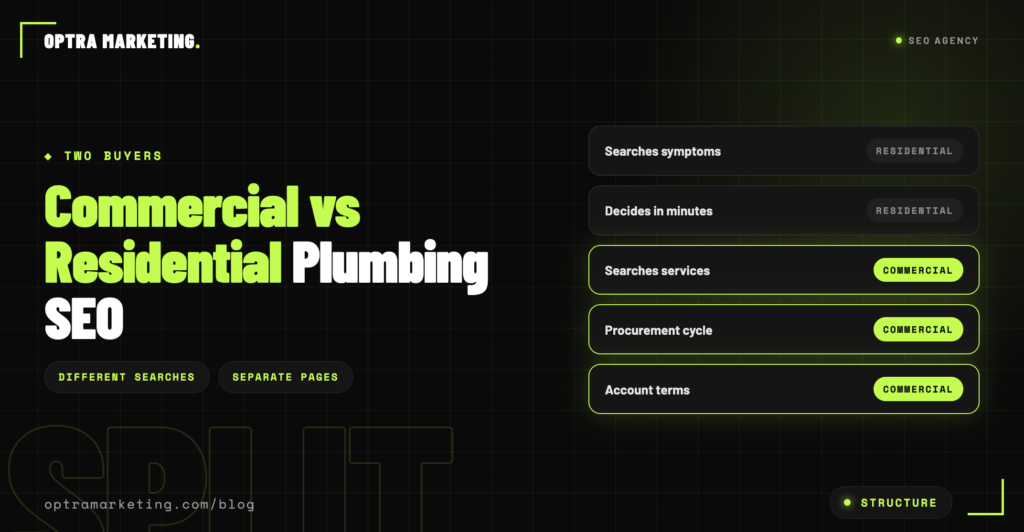
A homeowner with a burst pipe is stressed, acting alone, and deciding in minutes. A facilities manager with a failed system in a commercial kitchen is working to a service level agreement, may need three quotes for procurement, and is thinking about business interruption rather than inconvenience.
That changes the language. Homeowners search for symptoms: blocked drain, no hot water, leaking pipe. Commercial buyers search for services and compliance: commercial drainage contractor, backflow testing, grease trap servicing, planned preventative maintenance.
It also changes the timeline. Emergency residential work is decided the same hour. Commercial contracts frequently take weeks, involve more than one decision maker, and are renewed rather than bought once.
What Commercial Plumbing Clients Want to Know
The reassurances differ almost entirely from the residential side.
Insurance limits and public liability cover, since a commercial site carries larger exposure. Accreditations and compliance credentials relevant to the sector. Out-of-hours and weekend availability, because most commercial work has to happen outside trading hours. Response time commitments in writing rather than as a general claim. Whether you can handle a portfolio of sites rather than a single address. Invoicing and account terms, since procurement rarely pays a card machine on the doorstep.
Almost none of that appears on a homeowner-facing page, and its absence reads as a business that does not do this work seriously.
Structuring a Plumbing Website for Both Markets
The workable approach is a clearly separated commercial section rather than commercial paragraphs threaded through residential pages.
That means its own landing page, its own service pages for the commercial-specific work you offer, and its own case examples where you have them. The residential side stays as it is. Navigation should let a facilities manager reach the commercial section in one click rather than reading past bathroom installations to find it.
This is a content strategy decision more than a design one, and it is worth settling before publishing rather than retrofitting later.
Google Business Profile Settings for Commercial Plumbing
One profile can serve both, provided the categories reflect it. Plumber as primary, with secondaries covering the commercial services you genuinely provide.
Service areas need thought too. Commercial coverage is often wider than residential, since a maintenance contract justifies travel that a domestic call-out does not. If that is true for you, the website should reflect the difference rather than publishing a single blanket area that misrepresents both.
Photographs matter differently here. Commercial buyers respond to plant rooms, larger installations, and evidence of scale, not bathroom refits.
Reviews and Proof for Commercial Plumbing Work
Commercial buyers read reviews, but they weigh different things. Reliability, response times honoured, minimal disruption to trading, and clean documentation matter more than whether the engineer was friendly.
The practical difficulty is volume. Commercial clients leave reviews far less readily than homeowners, which means a plumbing business with hundreds of domestic reviews may have almost nothing visible for the commercial side. Building a consistent review habit applies here too, it simply needs asking deliberately at contract milestones rather than at job completion.
Where reviews are thin, written case examples and named accreditations carry more of the load.
Which Side of Plumbing to Prioritise
Worth deciding explicitly rather than drifting.
Residential is higher volume, faster to convert, and easier to rank for. Commercial is lower volume, slower, and considerably more valuable per client because contracts recur. A plumbing business splitting effort evenly across both usually underserves whichever one is not its default.
The useful question is where you want to be in three years. If the answer is contract work with predictable monthly revenue, the commercial section deserves building properly now, because it takes longer to mature than the residential side does.
Frequently Asked Questions About Commercial Plumbing SEO
Do plumbing companies need separate pages for commercial work?
Yes, if commercial is revenue you actually want. The buyer, the concerns, and the search terms are entirely different, and a homeowner-facing site rarely produces commercial enquiries regardless of how well it ranks. A mention on a services page is not enough to compete. A single line on a services page signals a residential contractor who occasionally takes commercial jobs.
What do commercial plumbing clients search for?
Services and compliance rather than symptoms: commercial drainage contractor, backflow testing, grease trap servicing, planned preventative maintenance. Homeowners search what is wrong, commercial buyers search what they need procured, which is why the two require genuinely different page content. Writing commercial pages in homeowner language undermines credibility with exactly the buyer you are targeting.
Can one Google Business Profile cover commercial and residential plumbing?
Yes, using a primary plumber category with secondaries for the commercial services you genuinely offer. The differentiation happens mostly on the website rather than the profile, though photographs showing plant rooms and larger installations help signal that you serve both markets. Photographs showing plant rooms and larger installations reinforce that you genuinely serve both markets.
Is commercial plumbing SEO harder than residential?
Slower rather than harder. Search volume is lower, sales cycles are longer, and enquiries are fewer. The trade-off is value, since commercial contracts recur and a single client can be worth more than dozens of domestic call-outs over the same period. That trade-off makes it a strategic decision about revenue mix rather than a marketing preference.
How do plumbers get reviews from commercial clients?
By asking deliberately at contract milestones rather than at job completion, and by asking the right person. Commercial clients leave reviews far less readily than homeowners, so where volume is thin, written case examples and named accreditations carry more of the persuasive weight. Asking the right person matters too, usually the facilities contact rather than accounts or procurement.
Should commercial plumbing pages show pricing?
Rarely fixed pricing, since commercial work is quoted per site. What helps is explaining how contracts are structured, what a maintenance agreement typically includes, and what drives cost, which is what a procurement buyer needs to compare proposals fairly. That level of transparency also filters out enquiries you were unlikely to win on price anyway.
Do commercial plumbing service areas differ from residential?
Frequently, yes. A recurring maintenance contract justifies travel that a one-off domestic call-out does not. If your commercial radius is genuinely wider, the website should say so rather than publishing a single blanket service area that misrepresents both sides. Publishing a single blanket radius misrepresents both sides and produces mismatched enquiries in each.
How long does commercial plumbing SEO take?
Longer than residential, typically six months or more before meaningful enquiry volume. The searches are lower in volume and the buying cycle is slower, so the same work produces fewer, later, but considerably more valuable enquiries than the domestic equivalent. That is why it needs starting before you need it rather than when residential work slows down.
Decide Which Business You Are Building
Most plumbing companies do both and market as though they only do one.
That is understandable, since residential volume pays the bills now and commercial work is a slower build. But the slower build is exactly why it needs starting before you need it, and a commercial section built this year is what produces contract enquiries next year.
If commercial work is where you want the business to be in three years, the website needs to reflect that ambition before the market can respond to it.
We structure local SEO for plumbers around which side of the business you actually want to grow. Month to month, no lock-in, and rankings improve within 90 days or we keep working for free.
Book a free strategy call and we will map out what your commercial section would need.
