
Local SEO for Law Firms: Why “Near Me” Searches Matter More Than Rankings
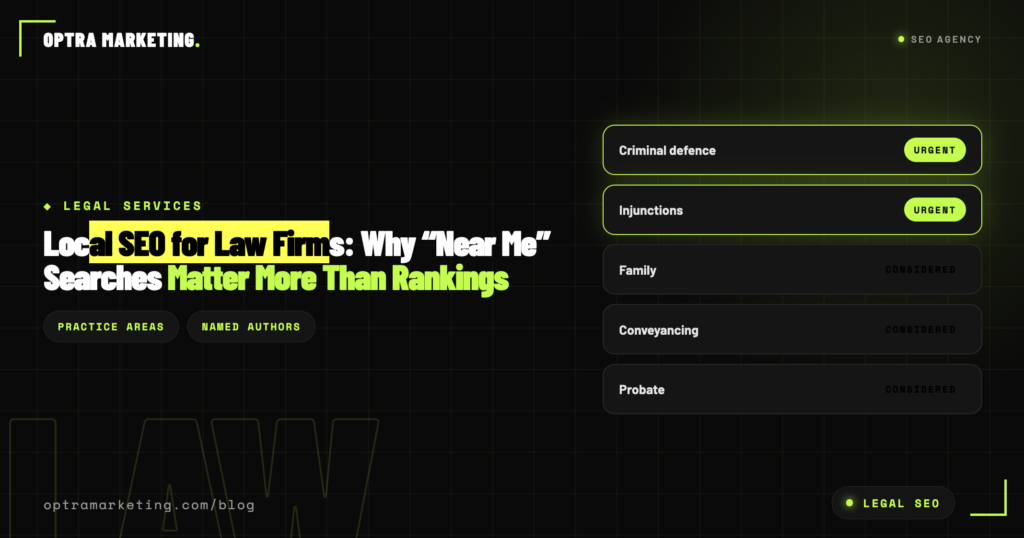
Ranking for “solicitor” or “law firm” in a competitive city is an expensive fight with limited payoff, because the person typing that has not yet decided what they need. The searches that actually produce clients are narrower, more urgent, and much more specific: a practice area, plus a location, plus a problem.
Law firms that understand that difference tend to outperform firms with bigger budgets chasing broader terms, which is the premise behind our local SEO for law firms.
Why Every Practice Area Needs Its Own SEO Strategy
A person searching for help with a divorce and a person searching about a workplace injury have almost nothing in common beyond needing a lawyer. Different emotional state, different urgency, different questions, different decision process.
A single “our services” page listing eight practice areas serves none of them well. Each practice area genuinely needs its own section of the site, written for that specific client’s situation, not a paragraph within a general overview. This is the single biggest structural difference between law firms that do well in local search and those that do not.
Writing Legal Content for How Clients Actually Feel
Most people contacting a solicitor are having a bad week. They are dealing with a divorce, a death, an accident, a dispute, or a criminal matter. They are often frightened, frequently confused about the process, and almost always worried about cost.
Content acknowledging that directly outperforms content written in formal legal register. A page explaining what happens in the first meeting, how long a process typically takes, and roughly what it costs does more to generate an enquiry than a page listing expertise in the third person. Very few firms write this way, which is precisely why it works.
Urgent vs Considered Practice Areas
Criminal defence, emergency injunctions, and certain immigration matters behave like emergency trades: the search happens under pressure, the decision is fast, and the priority is being immediately reachable with a phone number that works and a profile inspiring confidence within seconds.
Conveyancing, wills and probate, employment disputes, and most family matters behave the opposite way. The client researches over days or weeks, often reading several firms’ content before contacting anyone, and compares on clarity and reassurance rather than availability.
A firm covering both needs to build them differently. Urgent areas want speed and prominence. Considered areas want depth and explanation.
How Local Intent Works in Legal Searches
Legal searches carry unusually high local intent even when the term does not include a location. Someone searching “employment solicitor” almost always means one they can reasonably reach, and Google treats it accordingly. The Google Business Profile therefore does more work for law firms than many assume.
A firm with several offices needs each one properly established rather than run through a single profile. Handling that is the same discipline as local SEO across multiple locations in any sector: separate profiles, separate location content, and no duplicated pages differing only by town name.
Legal Fee Transparency as a Competitive Advantage
The profession is famously reluctant to discuss fees publicly, which creates an obvious opening. “How much does a solicitor cost for [x]” is searched constantly and answered rarely.
A page explaining fee structures, what fixed fees cover, when hourly rates apply, and what drives cost up, answers a genuine question without committing to a number for an unseen case. Firms doing this receive better-qualified enquiries, because the client arrives understanding roughly what they are entering into.
Managing Reviews Under Client Confidentiality
Confidentiality makes reviews harder in law than most industries, and many firms avoid the topic entirely. That is a mistake, since prospective clients read them regardless and an empty profile reads worse than a modest one.
Reviews focused on experience rather than outcome, communication, clarity, whether the client felt supported, are both appropriate and more useful to a reader than case results. Responses should be brief and non-specific for obvious reasons.
E-E-A-T and Named Authorship for Legal Content
Legal content sits in the same higher-scrutiny category as health content. Pages written anonymously, with no named solicitor and no qualifications, are at a structural disadvantage against a competitor whose content carries a real practitioner’s name and credentials.
This is one of the sectors where expertise and trustworthiness signals matter most, and increasingly they determine whether an AI answer cites your firm or a competitor’s.
Frequently Asked Questions About Law Firm SEO
Should law firms target broad terms like “solicitor near me”?
Partly, but practice-area terms convert far better and face less competition from firms with larger budgets. Broad terms also attract enquiries outside your actual specialisms, which costs staff time filtering people you were never going to help. The person typing a broad term has not yet decided what they need. The person typing a broad term has usually not worked out what kind of help they need.
How many practice area pages does a law firm need?
One properly developed page per practice area you actively want work in, rather than thin pages covering everything the firm technically handles. Depth across four areas consistently beats shallow coverage of twelve, and the shallow pages dilute the authority of the ones genuinely worth ranking. The shallow pages also dilute the authority of the ones genuinely worth ranking.
Do law firms need to publish their fees?
Publishing how fees work, fixed versus hourly, what is included, and what drives cost up, produces better-qualified enquiries without committing to a number for an unseen matter. It is also a heavily searched question almost nobody in the profession answers, which makes it an unusually open opportunity. It is a heavily searched question almost nobody in the profession answers, which makes it unusually open ground.
How should multi-office law firms handle local SEO?
Each office needs its own Google Business Profile and genuinely distinct location content, since each competes in a separate local market with different competitors. Duplicated pages differing only by town name typically fail to rank at all, and can drag down the pages that would otherwise perform. Duplicated pages differing only by town name can drag down the ones that would otherwise perform.
Can law firms ask clients for Google reviews?
Yes, within your regulator’s rules, focusing on the experience rather than the outcome of the matter. Reviews about communication, clarity, and feeling supported are both appropriate and more persuasive to a prospective client than case results, which raise confidentiality problems and set unrealistic expectations. Outcome-focused reviews also raise confidentiality problems and set unrealistic expectations for the next client.
Does a law firm need named authors on its content?
Increasingly yes. Legal sits in a high-scrutiny content category alongside health and finance, and pages carrying a named, credentialed solicitor outperform anonymous ones in traditional rankings. Named authorship also improves the likelihood of being cited when someone asks an AI assistant a legal question. It also improves the likelihood of being cited when someone asks an AI assistant a legal question.
How long does SEO take for a law firm?
Typically three to six months for meaningful movement, longer in competitive city markets where established firms have years of authority. Urgent practice areas often move faster than considered ones, since fewer firms build properly for the immediate, high-pressure searches where speed of contact decides everything. Urgent practice areas often move faster, since fewer firms build properly for high-pressure searches.
Should law firms blog about legal news?
Rarely worth the effort. Prospective clients search about their own problem, not about sector developments or recent judgments. Explanatory content about process, timelines, and cost consistently outperforms commentary on legislation, because it answers what someone frightened and confused actually typed into the search box. Explanatory content about process, timelines, and cost consistently outperforms commentary on recent judgments.
Start Where the Enquiries Are Worth Most
Most firms have one or two practice areas that are both profitable and something they genuinely want more of, and several others that simply exist. Building properly for the first group and leaving the second as brief listings is almost always the right allocation, even though it feels uncomfortably narrow.
Broad visibility across every practice area sounds better and performs worse, because it means competing weakly everywhere instead of strongly where it counts.
Working out which practice areas deserve that investment, and what the local competition actually looks like for each, is where our work with law firms starts. Month to month, no lock-in, and rankings improve within 90 days or we keep working for free.
Book a free strategy call and we will identify which practice areas are worth building around.
