
Roofing SEO for Commercial vs Residential Contractors
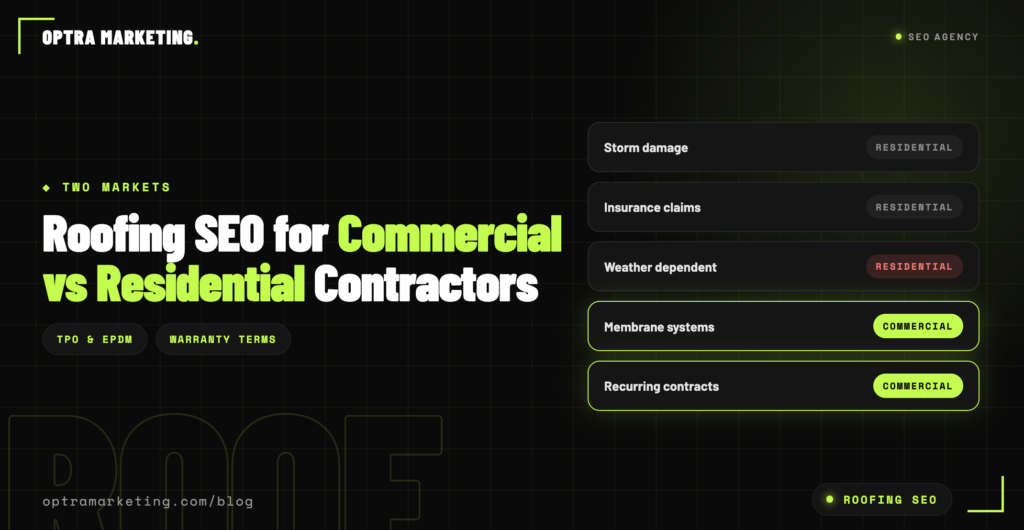
Most roofing websites are built for homeowners. Storm damage, replacement costs, insurance claims, all written for someone standing in their own driveway looking up at missing shingles.
For a roofing contractor that also wants commercial work, that creates a gap. The commercial buyer is a different person entirely, searching different terms, worried about different things, and buying on a completely different timeline.
How Commercial Roofing Buyers Differ From Homeowners
A homeowner with a leak is emotional, acting alone, and often deciding within days. A facilities manager with a failing flat roof is managing a budget cycle, may need to justify the spend internally, and is thinking about business interruption, warranty terms, and lifecycle cost.
The purchase is also rarely urgent in the same way. Commercial roofs are frequently replaced on a planned schedule rather than after a failure, which means the search happens months before any work begins and involves comparison rather than panic.
That difference runs through everything: the terms they search, the content that convinces them, and how long it takes from first visit to signed contract.
Commercial Roofing Search Terms and Systems
Homeowners search materials and symptoms: roof replacement cost, missing shingles, roof leak repair.
Commercial buyers search systems and services: TPO roofing contractor, EPDM installation, flat roof restoration, roof coating systems, planned roof maintenance, roof asset management. The vocabulary is technical because the buyer is technical, and content written in homeowner language reads as a residential contractor dabbling.
This is one reason a single roofing page cannot serve both. The terms barely overlap.
What Commercial Roofing Clients Need to See
The reassurances differ almost entirely from the residential side.
Warranty terms, both manufacturer and workmanship, stated clearly rather than promised vaguely. Insurance and liability cover appropriate to commercial exposure. Manufacturer certifications, since most commercial systems require an approved installer for the warranty to hold. Evidence of scale, meaning square footage completed rather than houses finished. Safety credentials and site management. Whether you can work around trading hours to avoid disruption. Whether you can handle a portfolio of buildings rather than one address.
Almost none of that belongs on a homeowner page, and its absence signals a business that does residential work and occasionally takes a commercial job.
Structuring a Roofing Website for Both Markets
The workable approach is a clearly separated commercial section rather than commercial mentions threaded through residential content.
Its own landing page, its own pages for the systems you install, and its own project examples with square footage and building type rather than street names. The residential side stays as it is. Navigation should let a facilities manager reach the commercial section immediately rather than scrolling past storm damage content aimed at homeowners.
This is a structural decision worth settling before publishing, since retrofitting a commercial section into an established residential site is considerably more work than building it separately from the start.
Google Business Profile Setup for Commercial Roofing
One profile can serve both. Roofing contractor as primary, with secondary categories reflecting the commercial systems and services you genuinely provide.
Photographs matter differently. Commercial buyers respond to scale: large flat roof installations, plant and access equipment, completed membrane work. A gallery of residential shingle jobs signals the wrong thing to someone responsible for forty thousand square feet.
Service areas often differ too, since a commercial contract justifies travel that a domestic repair does not. If that is true for your business, the site should reflect it rather than publishing one blanket area covering both.
Reviews and Proof in Commercial Roofing
Commercial buyers read reviews but weigh different things: reliability, minimal disruption, documentation quality, and whether the project finished on schedule.
The practical problem is volume. Commercial clients rarely leave Google reviews, which means a roofing contractor with two hundred residential reviews may have almost nothing visible for commercial work. Building a consistent review habit still applies, it simply needs asking at project handover and asking the right person in the organisation.
Where reviews are thin, named certifications, warranty terms, and written project examples carry more of the persuasive weight.
Which Side of Roofing to Prioritise
Worth deciding explicitly rather than drifting into both.
Residential is higher volume, faster to convert, and in storm markets can be enormously profitable in a compressed window. Commercial is lower volume, slower, and more predictable, with contracts that recur and revenue that does not depend on weather.
That last point matters in storm markets particularly. A roofing business entirely dependent on residential storm work has a difficult nine months every year. Commercial work smooths that curve, which is a strategic argument as much as a marketing one.
Frequently Asked Questions About Commercial Roofing SEO
Do roofing contractors need separate pages for commercial work?
Yes, if commercial is revenue you genuinely want. The buyer, the search terms, and the concerns are entirely different from residential, and a homeowner-facing site rarely produces commercial enquiries regardless of how well it ranks for residential terms. Commercial mentions threaded through residential content rarely rank and rarely convince the buyer either.
What do commercial roofing buyers search for?
Systems and services rather than symptoms: TPO roofing contractor, EPDM installation, flat roof restoration, roof coating systems, planned maintenance. The vocabulary is technical because the buyer is, and homeowner language on a commercial page reads as a residential contractor dabbling. Matching that vocabulary is one of the clearer signals that you genuinely operate in this market.
Can one Google Business Profile serve commercial and residential roofing?
Yes, with a roofing contractor primary category and secondaries covering commercial systems you genuinely install. The bigger differentiation happens on the website, though photographs showing scale rather than residential shingle work help signal that you serve both. Service areas often differ too, since a commercial contract justifies travel a domestic repair does not.
Is commercial roofing SEO harder than residential?
Slower rather than harder. Lower search volume, longer buying cycles, and fewer enquiries overall. The trade-off is value and predictability, since commercial contracts recur and do not depend on whether a storm arrives in a given season. For storm market contractors particularly, that predictability is worth as much as the revenue itself.
How do roofing contractors get commercial reviews?
By asking at project handover and asking the right person, usually the facilities manager rather than procurement. Commercial clients rarely leave reviews unprompted, so where volume stays thin, certifications and written project examples carry more of the weight. Certifications, warranty terms, and written project examples fill the gap while review volume builds slowly.
Should commercial roofing pages show pricing?
Rarely fixed pricing, since commercial work is quoted per building. What helps is explaining how projects are costed, what a maintenance agreement typically covers, and what drives cost, which is what someone preparing an internal business case actually needs. Explaining how projects are costed also helps a buyer prepare the internal case for approving the work.
Do commercial roofing service areas differ from residential?
Frequently, yes. A large commercial contract justifies travel that a domestic repair does not. If your commercial radius is genuinely wider, say so on the site rather than publishing one blanket service area that misrepresents both sides of the business. Stating the difference clearly stops residential enquiries arriving from places you would decline to attend.
How long does commercial roofing SEO take to produce leads?
Longer than residential, typically six months or more before meaningful volume. Buying cycles alone can run several months from first search to contract, so the enquiries arrive later but are considerably more valuable when they do. The enquiries arrive later but are considerably more valuable and far less dependent on the weather.
Build the Side That Smooths the Year
For roofing contractors in storm markets particularly, the commercial question is not only about revenue mix. It is about whether the business has anything happening in the months when no storm arrives.
Residential storm work is lucrative and unpredictable. Commercial work is slower and dependable. A contractor doing both has a considerably easier year than one waiting on weather, and the commercial side takes long enough to build that it needs starting before you need it.
If commercial is where you want more of the business in three years, the site needs to say so now, because the market cannot respond to an ambition that is not published anywhere.
We structure roofing local SEO around which side of the business you actually want to grow. Month to month, no lock-in, and rankings improve within 90 days or we keep working for free.
Book a free strategy call and we will map out what your commercial section would need.
