
What Industries Need Local SEO the Most in 2026
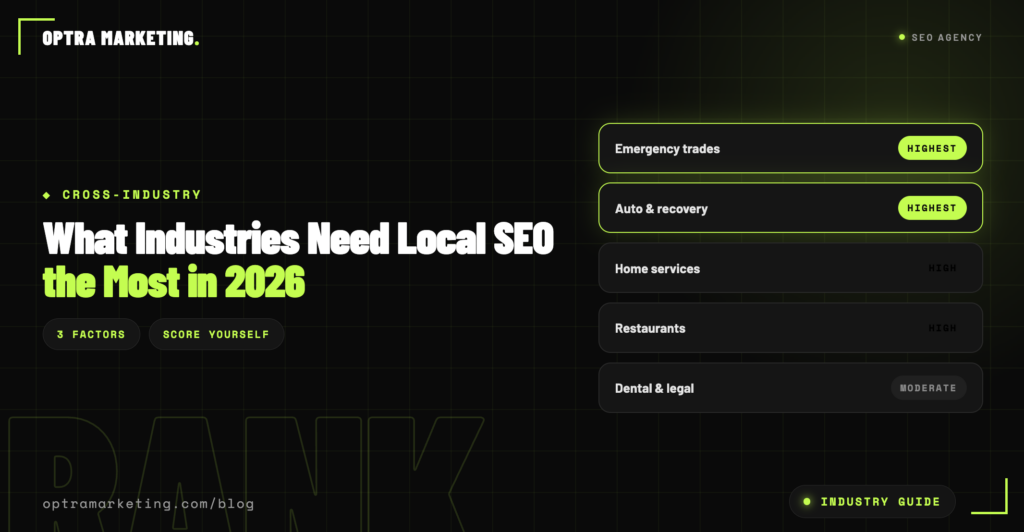
Local SEO is frequently sold as universally necessary, which is not quite true. Some businesses would see revenue barely move if they vanished from local search tomorrow. Others would be in serious trouble within a month.
The difference comes down to three factors, and the industries scoring highly on all three are those where local search is not a marketing channel but the primary way customers arrive.
The Three Factors That Determine Local SEO Dependency
Urgency: Does the customer need this now, or can the decision wait weeks? Urgent needs get searched rather than researched, and the business appearing first captures a disproportionate share.
Geographic constraint: Must the customer use someone nearby? A plumber must be local. A software consultant need not be. The tighter the constraint, the more local search governs the outcome.
Absence of an established alternative: Does the customer already have someone they use? People have a regular dentist and no regular emergency plumber, which changes whether they search at all.
Score high on all three and local search is close to the entire acquisition channel. Score low on all three and it is a supporting activity at best.
Highest-Dependency Industries for Local SEO
Emergency trades: Plumbing, electrical, HVAC, and emergency roofing sit at the top. Maximum urgency, tight geographic constraint, and almost nobody has a plumber on retainer.
Auto repair and recovery: Same profile, with an additional constraint: the vehicle often cannot travel far, tightening the geography further.
Locksmiths and glaziers: Extreme urgency, entirely local, and a category where almost no customer has a prior relationship.
High-Dependency Industries
Planned home services: Painting, general contracting, landscaping, removals. Lower urgency than emergency trades, but strong geographic constraint and rarely any incumbent relationship. Removals in particular sit unusually favourably, since almost everyone searching becomes somebody’s customer within weeks.
Restaurants and cafes: Enormous dependency, though the mechanism differs: the decision frequently happens inside the search result rather than on a website.
Salons and personal services. Strong geographic constraint, but a significant incumbent factor, which means searches skew toward people who recently moved or became dissatisfied.
Moderate-Dependency Industries
Dental and medical practices. Strong geographic constraint, but low urgency for routine care and a high incumbent rate. The exception is high-value elective treatment, where patients research extensively and will travel.
Legal services. Highly variable by practice area. Criminal defence and emergency injunctions are urgent and local. Conveyancing and probate are considered purchases where geographic constraint is weakening.
Veterinary practices. Similar to dental: high incumbent rate for routine care, high urgency for emergencies.
Where Local SEO Matters Less
Worth stating plainly, because the industry rarely does. Businesses serving national or international clients with no geographic constraint, businesses operating primarily on referral or contract renewal, and businesses found through procurement rather than search all get less from local SEO than the effort would suggest.
That does not mean it is worthless. It means it should not be the primary investment, and anyone selling it as such is not being straight.
What Changed for Local SEO Heading Into 2026
Two shifts are worth noting. First, the growth of AI-generated answers means visibility increasingly depends on being the source such systems draw from, which favours businesses with clear, well-structured content. Understanding why AI recommends some businesses and ignores others matters more each year.
Second, the incumbent factor is weakening across several categories. People switch providers more readily than they did, and check reviews before staying with someone as well as before choosing them, which raises dependency for industries that previously relied on inertia.
Frequently Asked Questions About Local SEO by Industry
Which industry depends on local SEO most?
Emergency trades: plumbing, electrical, and HVAC. Maximum urgency, tight geographic constraint, and almost nobody has an existing relationship with a plumber before they need one. For these businesses local search is close to the entire customer acquisition channel rather than one option among several. For these businesses local search is close to the entire acquisition channel, not one option among several.
Does local SEO matter for businesses with lots of repeat customers?
Less for retaining existing customers, but it still governs how new ones arrive. Any business with churn or growth ambition needs a pipeline, and for local services that pipeline runs through search. Relying entirely on an existing base works until the base shrinks, at which point building visibility takes months. Relying on an existing base works until it shrinks, at which point building visibility takes months.
Is local SEO worth it for a referral-based business?
As a supporting channel, usually yes. Referred prospects frequently search the business name before making contact, and a weak, inconsistent, or outdated presence quietly undermines a referral that was already working in your favour. It costs relatively little to make sure that check goes well. It costs relatively little to make sure that name check goes well when it happens.
Has AI search changed which industries need local SEO?
It has changed the mechanism more than the ranking of industries. The same businesses depend on being found, but the route now runs partly through AI-generated answers alongside traditional results, which favours businesses with clear, well-structured, genuinely informative content over those relying on thin pages. It favours businesses with clear, well-structured content over those relying on thin pages.
Do B2B companies need local SEO?
Rarely as a primary channel, unless they serve a defined geographic area. Businesses found through procurement processes, long-term contracts, or national outreach get considerably less from local search than the effort would suggest, and anyone selling it to them as essential is not being straight. Anyone selling it to them as essential is not being straight about where the returns come from.
Which industries have the least competitive local SEO?
Typically those where fewer businesses have built a proper local presence: removals, some specialist trades, and several professional services. Low competition does not automatically mean high value though, so it is worth checking that genuine search demand exists before treating it as an opportunity. Low competition does not automatically mean high value, so check demand exists before treating it as opportunity.
How do I score my own business on these three factors?
Ask how fast your customer decides, whether they must use someone nearby, and whether most already have a provider they use. Three yeses means local search is your primary acquisition channel rather than one option among several, and should be resourced accordingly. Three yeses means local search should be resourced as a primary channel rather than a side activity.
Does business size affect how much local SEO matters?
Less than industry does. A one-van plumber and a twenty-van plumbing company both depend on local search for new customers in the same way. What differs is the scale of investment that makes sense, not whether the channel matters to the business at all. What differs is the scale of investment that makes sense, not whether the channel matters at all.
Score Your Own Business Honestly
The useful exercise is applying the three factors to your own situation rather than to your industry as a whole, because businesses within the same industry frequently score differently.
A roofing company doing mostly storm response scores far higher on urgency than one doing planned commercial re-roofing. A dental practice focused on implants has a much weaker geographic constraint than one doing routine family care.
Where you land on those three determines not whether to invest in local SEO, but how much of your total effort it deserves relative to everything else.
We are straight about this with prospective clients, including when local SEO is not the highest-return thing available to them. Month to month, no lock-in, and rankings improve within 90 days or we keep working for free.
Book a free strategy call and we will score your business against all three.
