
Why Video and Images Help You Rank in Google and AI Search
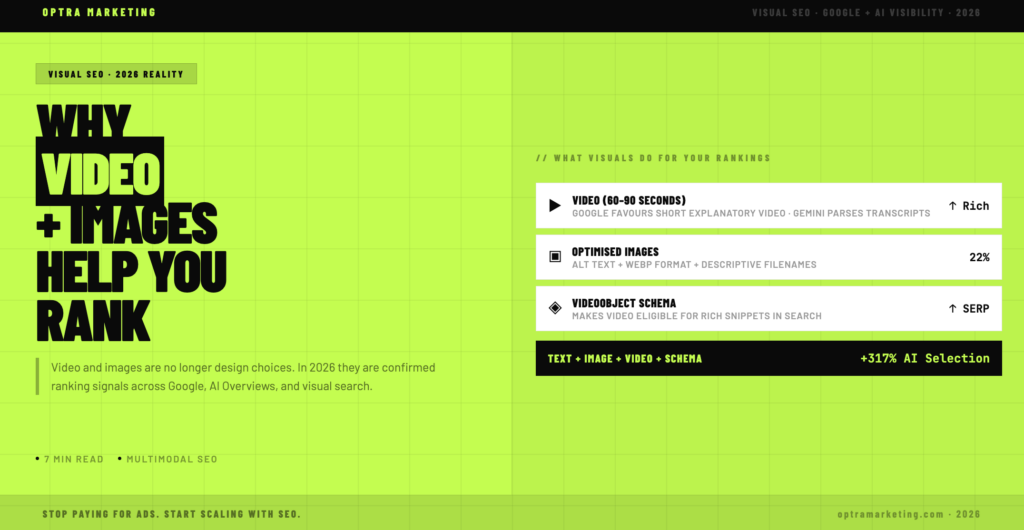
Most local businesses treat images as decoration and video as optional. In 2026 that approach is quietly costing rankings, because video and images for SEO rankings have become genuine visibility channels, with their own ranking signals, their own place in AI results, and their own ability to drive inbound traffic.
Here is what changed and what it means practically for your business.
Images Are a Separate Traffic Channel Now
Google Images drives roughly 22% of all web searches, and Google Lens now processes over 20 billion visual queries every month, with visual search adoption growing at around 30% annually. Image SEO in 2026 is a distinct traffic channel with its own ranking signals, optimisation playbook, and rich result formats.
For a local service business this matters more than it might seem. A homeowner who photographs their own roof with Google Lens after spotting damage is a high-intent customer. A cleaning business with before-and-after job photos properly optimised for image search is discoverable in ways its text-only competitors are not.
Images now appear across web results, AI Overviews, Google Discover, and Google Lens, not just the Images tab. Businesses that optimise their visual content can capture traffic that most competitors are ignoring entirely.
The Basics Most Businesses Skip
The gap between well-optimised and completely unoptimised images usually comes down to three simple things that take minutes to fix.
File names. A photo saved as IMG_4829.jpg tells Google nothing. A photo saved as houston-roof-replacement-completed.jpg tells it exactly what the image shows and where it is relevant. Descriptive, hyphenated file names are one of the two highest-impact image SEO signals.
Alt text. Alt text is the written description of what an image contains. It is primarily an accessibility feature, but it is also how Google and AI engines read your images. Write it naturally and accurately, describing what is actually in the photo, without keyword stuffing. Alt text is the second of the two highest-impact signals, and it now influences whether your images surface in Google Lens results too.
File format and size. Large uncompressed images slow your page down, which hurts both your Core Web Vitals score and your rankings. The format priority in 2026 is AVIF first, WebP as a fallback, and JPEG or PNG only for legacy support. WebP alone delivers files 25 to 35% smaller than JPEG with no visible quality loss, and most website platforms can serve it automatically once configured.
If your site is image-heavy, an image sitemap is the final basic worth adding. It tells Google exactly which images exist on your site and where, instead of leaving discovery to chance.
Why Images Help With AI Visibility
Modern AI is multimodal, meaning it understands and connects text, images, and video simultaneously. Pages that combine formats give AI engines more surface area to extract from and more confidence that the source is comprehensive and credible.
The numbers behind this are striking. Third-party studies report that pages combining text with images, video, and proper schema markup see citation selection rates up to 317% higher than text-only pages. These are observational findings rather than confirmed Google ranking factors, but the direction is consistent across every study on images in AI search: multimodal pages get selected, single-format pages get skipped.
For a local business the practical translation is simple. A strong written answer supported by relevant, properly labelled images is more citable than the same answer standing alone.
What Video Does for Local Businesses
Video SEO for local business has historically felt out of reach, something only brands with production budgets could do. The reality in 2026 is that short, simple, informative video is one of the most effective additions to a service page or blog post.
Google favours short videos of 60 to 90 seconds that explain one concept quickly. These rank well because they skip long intros and jump directly to solving the problem, which matches exactly what Google’s AI systems want to surface.
A roofing contractor recording a 90-second walkthrough of a completed job, a plumber filming a quick explanation of what a water heater replacement involves, a cleaning business showing a before-and-after transformation: these are the videos that support both rankings and trust, and all of them can be shot on a phone.
One requirement has changed. AI tools like Gemini and Perplexity can now parse transcripts, captions, and spoken context to understand exactly what is said in a video. Your video’s actual content and clarity matter as much as its metadata, which means adding captions and a written transcript to every video you publish is no longer optional for visibility purposes.
Schema Makes Visuals Machine-Readable
Just as schema markup helps AI tools read your text, VideoObject and ImageObject schema help them read your visual content. Adding VideoObject schema to embedded videos makes them eligible for rich video snippets in search results, which appear separately from regular blue links and drive additional click-through.
This connects directly to the broader question of [whether you need schema markup to show up in AI search]. For visual content specifically, the answer is clearly yes. Schema is the difference between a video that appears as a rich result and one that sits invisible on a page Google cannot interpret.
The Practical Starting Point
You do not need a production team. You need a phone and a willingness to show your actual work.
Start with your most important service pages and add one relevant, well-captioned image with a descriptive file name and accurate alt text to each. Then record a short video for your highest-value service and embed it on that page with VideoObject schema, captions, and a transcript.
Both steps are small, both produce compounding value over time, and both are areas your competitors are most likely ignoring.
How Optra Marketing Can Help
Visual content SEO is part of the technical work we do alongside content and schema. We audit your existing images for missing alt text and file name issues, recommend format upgrades where they will have the most impact, and implement VideoObject schema for any video content on your key pages.
If you want to see which pages on your site are missing visual signals entirely and where adding them would have the most ranking impact, a free audit covers exactly that. It is one of the faster wins available for most local business websites.
