
Home Service SEO vs Local SEO for Retail and Hospitality
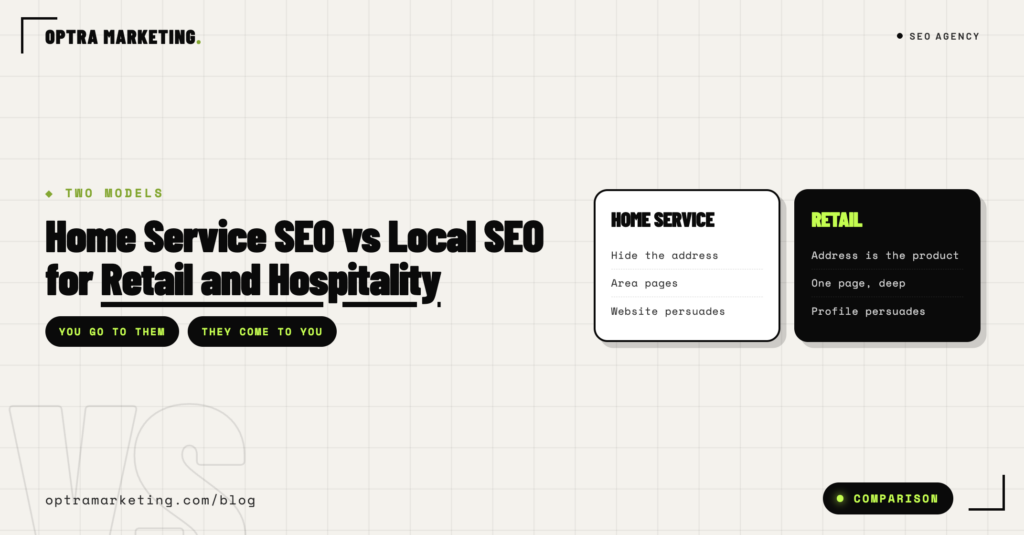
There is one structural difference that changes almost everything about local SEO strategy: does the customer come to you, or do you go to them?
A plumber travels to the customer. A cafe waits for the customer to walk in. Both are local businesses competing in local search, and beyond the shared fundamentals their strategies diverge substantially.
Service Area vs Physical Address: The Core Difference
For a home service business, the physical address is largely irrelevant to the customer and often deliberately hidden. What matters is the service area, the list of places you will travel to. Nobody hiring a plumber cares where the van is parked overnight, which is why ranking a service business without showing your address is a supported configuration rather than a compromise.
For retail and hospitality, the address is the product. Where you are determines whether someone can conveniently visit, and a customer three miles away may as well be thirty if parking is difficult.
This single difference cascades into how Google Business Profiles are configured, what pages the website needs, and how citations are built.
Area Pages vs a Single Deep Location Page
Home service businesses need coverage, which makes this largely a content strategy problem. Pages for each town or area served, each genuinely specific, because the customer is searching with their own location in mind and needs to confirm you will come to them.
Retail and hospitality need depth on one location rather than breadth across many. Directions, parking, public transport, nearby landmarks, accessibility, opening hours including holidays. A single page done thoroughly beats a dozen area pages that are largely irrelevant, since nobody searches “cafe in [town twenty minutes away]” hoping it will come to them.
What Each Type of Customer Wants to Know
For home services: whether you cover their area, whether you handle their specific problem, roughly what it will cost, and how quickly you can attend. Content answering those four questions converts.
For retail and hospitality: whether you are open now, exactly where you are, what you have or serve, and what it looks like inside. Photographs and hours carry weight no amount of written content matches.
Getting this backwards is common. Restaurants publishing long “about our philosophy” pages while their opening hours are wrong, and plumbers with a beautiful gallery but no clear list of areas served, are making the same category error in opposite directions.
How the Map Pack Works for Each Business Model
For retail and hospitality, the map pack is frequently where the entire decision happens. Someone searching for coffee looks at what is nearby, checks photos and rating, and goes. The website may never be visited, which makes zero-click searches a win rather than a loss for these businesses specifically.
For home services, the map pack drives the call, but the website usually does more of the persuading, particularly for higher-value planned work where the customer compares two or three providers. Getting more calls from Google Maps is the goal in both cases, the difference is what happens after the tap.
Why Reviews Say Different Things in Each Model
Home service reviews are about the work and the person: did they turn up, was the price fair, was the job done properly, would you have them back.
Retail and hospitality reviews are about the experience and the place: was the food good, was it clean, was the service friendly, would you return. The rating itself does more visible work here, since it appears prominently at the moment of decision, whereas home service customers more often read the actual text.
Citations and Directories Diverge Too
Home service businesses benefit most from trade-specific directories: contractor listings, manufacturer certified-installer registers, trade association memberships. These carry authority within the trade and reach customers already looking for that category of work.
Retail and hospitality benefit from an entirely different set: mapping platforms, review aggregators, booking and reservation systems, tourism and local guide listings. A restaurant listed accurately across reservation platforms is reaching customers at the moment of decision in a way a trade directory never would.
Businesses copying a generic citation checklist end up submitting to directories carrying no relevance to their model.
What Transfers Between Both Models
Underneath the differences, the same foundations hold. Accurate, complete Google Business Profile. Consistent business information everywhere it appears. A fast site working properly on a phone. An active review habit. Content answering real questions rather than describing the business in the abstract.
The fundamentals do not care which model you operate. The strategy layered on top does.
Frequently Asked Questions About Service Area vs Location SEO
Should a home service business hide its address?
Usually yes, configuring as a service area business with the address hidden from public display. The service area is what matters to customers and the premises is not, and hiding it avoids giving the impression you only serve the immediate neighbourhood around your yard or unit. It avoids implying you only serve the immediate neighbourhood around your yard or unit.
Do restaurants need service area pages?
No. Depth on the single location, covering directions, parking, public transport, hours, and photographs, produces considerably more than breadth across areas customers will not travel from. A restaurant is not going to the customer, so pages implying otherwise serve nobody. A restaurant is not going to the customer, so pages implying otherwise serve nobody at all.
Which model relies more on the Google Business Profile?
Retail and hospitality, where the profile frequently carries the entire decision from discovery through to a booking or a walk-in. Home services rely on it heavily too, but the website does more of the convincing for considered, higher-value work where several providers are being compared. Home services rely on it heavily too, the website simply does more of the convincing.
Can a business be both a service area and a location business?
Yes, and it is more common than it used to be. A garage with a workshop that also does mobile callouts, or a salon offering mobile appointments. These need both approaches: location depth for the premises alongside genuine area coverage for the mobile side of the service. These need location depth for the premises alongside genuine area coverage for the mobile side.
Do home service and retail businesses need different directories?
Yes, substantially. Home services benefit from trade directories, professional associations, and manufacturer registers. Retail and hospitality benefit from mapping platforms, review aggregators, and booking systems. Generic citation checklists serve neither well and waste effort on listings nobody relevant will ever see. Generic citation checklists waste effort on listings nobody relevant will ever actually see.
How do reviews differ between the two models?
Home service reviews are read carefully for reliability and fairness, since the customer is inviting someone into their property. Retail reviews are more often scanned as a star rating at the point of choice. Both matter, but the text carries more weight in one and the number in the other. The text carries more weight in one model and the star rating in the other.
Should a service area business list every town it covers?
Only towns you genuinely work in and want more work from. Inflated service areas dilute relevance and produce enquiries from places you will end up declining, which wastes your time and theirs while teaching Google that your listing is a poor match for those searches. It also teaches Google your listing is a poor match for searches in those places.
What happens if my business model changed but the website did not?
You are optimised for what the business was rather than what it is now. A bakery now doing mostly wholesale, or a salon now offering mobile appointments, needs the site structure revisited before anything else, since no amount of content fixes a structure aimed at the wrong customer. No amount of content fixes a site structure aimed at the wrong customer entirely.
Work Out Which One You Actually Are
Most businesses know instinctively, but the edge cases are where mistakes happen, and there are more of them than there used to be.
A salon is a walk-in business until it starts offering mobile appointments. A bakery is retail until wholesale becomes half the revenue. A garage with a workshop and a recovery service is genuinely both, and needs the location depth of a retail business alongside the area coverage of a home service.
Where a business sits on that spectrum, and whether it has shifted since the website was built, determines whether the current structure is still right. Plenty of sites are optimised for what the business was five years ago.
We work out which model applies before scoping any local SEO, including for businesses that turn out to be both. Month to month, no lock-in, and rankings improve within 90 days or we keep working for free.
Book a free strategy call and we will check your site still matches your business model.
