
What Are The Most Common SEO Mistakes Roofing Companies Make?
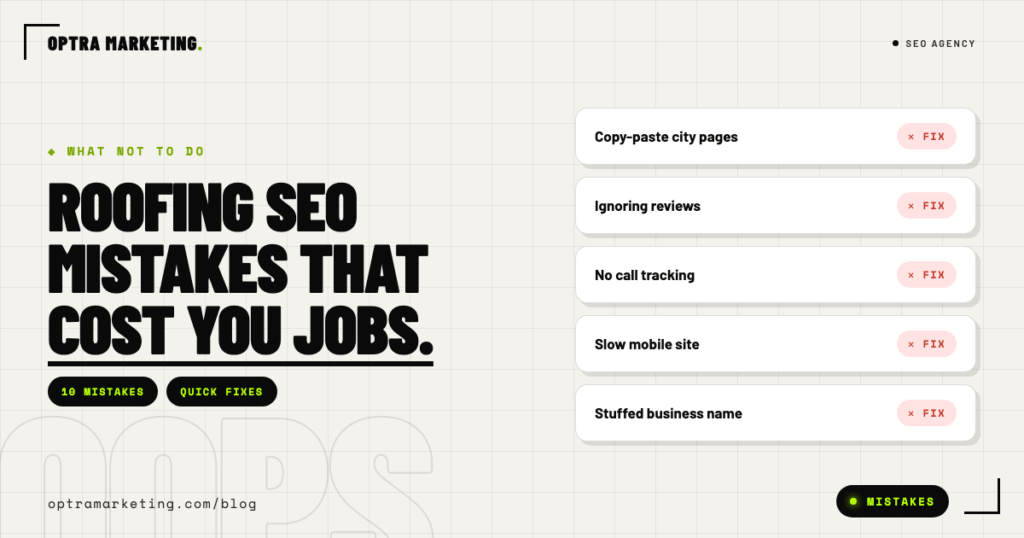
The most common roofing SEO mistakes are an incomplete Google Business Profile, one page trying to cover every service, no pages for the areas you serve, too few recent reviews, and tracking rankings instead of calls. None of them is hard to fix. Most roofers just never find out they’re making them, because the website looks fine and the monthly report says “traffic is up.”
Here are the ten we see most often, why each costs you jobs, and what to do about it.
1. A Google Business Profile that says almost nothing
A profile with the wrong category, no services listed and a handful of old photos gives Google very little to match to a search. The fix takes an afternoon: set “Roofing contractor” as the primary category, list each service, define your service areas honestly, and add real job photos. If you want the full walkthrough, we cover how to optimize your Google Business Profile as a roofing contractor.
2. One page for every service
A single “Services” page that mentions repair, replacement, gutters, siding and commercial work can’t rank well for any of them. Google looks for a page that clearly matches the search. Give each major job its own page, with its own heading, its own photos and its own questions answered.
3. No pages for the areas you serve
Homeowners search by place: “roofing company San Antonio,” “roof repair Minneapolis.” If you serve five cities and have one page that mentions them in a list, you’ll mostly rank where your office is. Build a real page for each area. Include local details, such as common roof types, weather problems and neighborhoods, so it isn’t the same text with the name changed.
4. Thin, duplicated content
Short pages with a few generic paragraphs, copied across several cities, are the most common reason pages never rank. We explain why short service pages don’t rank. The test is simple: could a homeowner learn something specific from this page that they couldn’t from your competitor’s?
5. Not enough recent reviews
Google weighs how many reviews you have and how recent they are. A roofer with 150 reviews from the last two years beats one with 40, the newest from last spring. Build review requests into the end of every job, and reply to everything. If you need a system, here’s how to get more Google reviews for your business.
6. Buying cheap links
Packages that promise hundreds of backlinks for a small monthly fee usually deliver links from low-quality sites, and these can hurt more than they help. A handful of relevant local links from suppliers, chambers and local press does more. We cover how this works in backlinks for roofing SEO.
7. Blocking your own pages by accident
It happens more than you’d think. A stray “noindex” setting, a page that exists at two different URLs, or navigation that links to a version of a page Google can’t index. The page looks fine to a visitor and never shows up in search. Check your key service pages in Google Search Console, and run through a technical SEO checklist once a quarter.
8. A slow or awkward mobile site
Homeowners often search for a roofer from a phone, in the middle of a problem. If the site is slow, the phone number is hard to tap, or the form is a pain, they call the next name on the list. We cover this properly in how mobile SEO affects roofing websites.
9. Tracking rankings instead of calls
A report that says “you moved from position 14 to position 9” tells you nothing about jobs. What matters is calls, booked estimates and revenue. Agencies that only report rankings can look successful while your phone stays quiet. We explain what to track in how to measure roofing SEO success.
10. Treating SEO as a one-time project
A site that gets built, optimized and left alone slides down as competitors keep publishing, collecting reviews and earning links. SEO for roofers works like maintenance on a roof: small, steady attention prevents the big problem. Set a rhythm of fresh reviews, new or refreshed pages and a quarterly check of your profile, and you’ll avoid most of the slide.
How to fix these in the right order
Don’t try to fix all ten at once. Work in this order, because each step makes the next one count for more:
- Profile first: A complete, accurate Google Business Profile is the fastest win, and it feeds everything else.
- Then the pages that earn jobs: Give repair, replacement and storm damage their own pages.
- Then your areas: Build real pages for the cities you want work in, starting with the biggest.
- Then reviews: Put a steady request system in place, so new reviews arrive every week.
- Then technical cleanup: Fix speed, mobile problems and anything blocking your pages.
- Then links: Earn a few quality local links once the pages are worth linking to.
- Then tracking: Set up call tracking so you can see what’s working.
Most of these fixes don’t need a bigger budget. They need attention in the right order.
How to find out which ones apply to you
You can check most of them in an hour:
- Open your Google Business Profile and look at the category, services and service areas.
- Search for “roof repair [your city]” and see whether any of your pages show up.
- Count your reviews from the last 90 days.
- Test your site on your own phone.
- Check Google Search Console for pages that aren’t indexed.
If you’d rather have someone else do it, a proper audit covers all of this and gives you a ranked list of fixes.
Quick self-check
Ask yourself:
- Does my profile list every service and area I cover?
- Does each service have its own page?
- Do I have a page for each city I want work in?
- Did I get new reviews in the last 30 days?
- Do I know how many calls came from Google last month?
If you answered no to two or more, there’s probably easy ground to win back. For the bigger picture, our complete roofing SEO guide covers what to build and in what order.
If you’d like us to check your site and profile for these problems, book a free roofing SEO audit with Optra Marketing today. No commitment required.


[…] Trust pages support everything else in local SEO for roofing. They help your service pages convert, your reviews carry more weight, and your area pages feel real. For the full picture, start with our roofing SEO guide, and if you want to see the common gaps, we list the common roofing SEO mistakes. […]