
How To Measure Roofing SEO Success: Calls, Estimates And Jobs
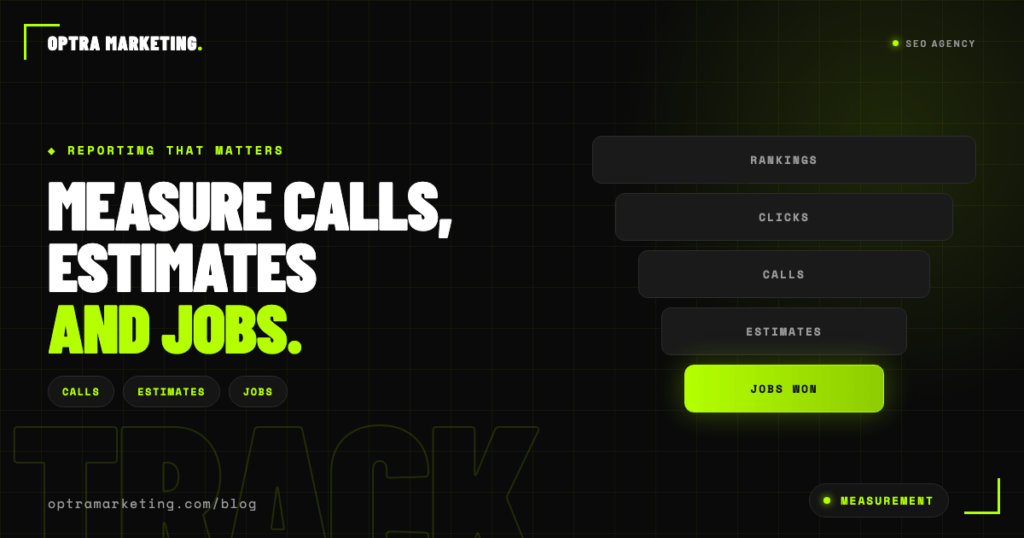
You measure roofing SEO success by counting calls, booked estimates and jobs won from Google, not by looking at rankings alone. Rankings and traffic are useful clues, but they’re one step removed from revenue. If the phone isn’t ringing more, the SEO isn’t working, no matter how the report looks.
This guide shows what to track, where to find each number, and how to put it together into a simple monthly view.
Start at the end: jobs and revenue
Work backwards from what pays the bills:
- Revenue from SEO: Jobs won that started with a Google search.
- Jobs won: Signed work, by source.
- Estimates booked: Appointments on the calendar.
- Calls and form fills: The first contact.
- Visits: People who landed on your pages.
- Rankings and impressions: Where you show up.
Most reports start at the bottom of that list. Start at the top. You can have strong rankings and weak calls if the pages don’t convert, and the reverse. Only the top of the list tells you if the work is paying off.
The numbers to track
| What to track | Where to find it | Why it matters |
|---|---|---|
| Phone calls from Google | Call tracking, Google Business Profile | The main way roofing leads arrive |
| Form submissions | Your website, Google Analytics | Estimate requests that aren’t calls |
| Booked estimates | Your CRM or calendar | Turns leads into real appointments |
| Jobs won and revenue | Your CRM or invoices | The only number that pays the crew |
| Profile actions: calls, directions, website clicks | Google Business Profile | Shows map pack performance |
| Organic visits to service and area pages | Google Analytics, Search Console | Shows which pages bring people in |
| Impressions and clicks per search | Google Search Console | Shows where you’re gaining visibility |
| Rankings for target searches | A rank tracker set to your service areas | Early signal, not the goal |
Set up call tracking first
Most roofing leads come by phone, and without tracking you can’t tell which ones came from Google. A tracking number on your website and a separate one on your profile will show which source produced each call. Many call tracking tools also record the calls, which helps you see whether the leads are good ones.
If you can’t set up tracking yet, add one habit: ask every new customer, “How did you find us?” and write the answer down.
Use Search Console and your profile
Google Search Console is free and shows what people searched before they saw your site, how often you appeared, and how often they clicked. Check it monthly for service and area pages, and look for searches where you appear a lot but get few clicks. That usually means a weak title or description.
Your Google Business Profile shows calls, direction requests and website clicks. This is the closest thing to a scoreboard for map results. If you want to dig into what to fix when those numbers are flat, our local SEO audit walks through the common causes.
Track rankings, but carefully
Rankings shift depending on where the searcher is. A search from your office won’t match a search from a customer’s street. Use a tool that checks rankings from points across your service area, and track a small set of searches that map to real jobs, such as “roof repair [city]” and “roof replacement [city].” A roofer serving San Antonio might track “roof repair San Antonio” and “roofing company San Antonio.” Ignore your own company name, because ranking for your brand doesn’t show growth.
What a good monthly report includes
- Calls and form submissions from Google, compared with last month
- Booked estimates and jobs won from those leads
- Profile calls, direction requests and reviews added
- Visits and impressions for your top service and area pages
- Ranking changes for your target searches
- What was done this month and what’s next
One page is enough. If a report is twenty pages of charts and doesn’t answer “did we get more work?”, it’s not helping.
What to expect and when
SEO builds over time. Most roofing companies see movement in 60 to 90 days, and the first sign is often visibility, such as more impressions and better positions, before calls rise. Jobs follow. For a realistic timeline, see how long local SEO takes to show results.
What a simple example month looks like
Here’s an illustration with made-up numbers, to show the shape of a useful report, not what you should expect:
| Measure | Last month | This month |
|---|---|---|
| Calls from Google | 18 | 24 |
| Form requests | 6 | 8 |
| Estimates booked | 9 | 13 |
| Jobs won | 3 | 5 |
| Profile calls | 11 | 15 |
| New reviews | 4 | 7 |
The story in that table is clear: more calls, more estimates and more jobs, with reviews growing at the same time. If the rankings moved a little but these numbers didn’t, you’d know to look at the pages and the calls instead of celebrating a position.
Roofing is seasonal, so compare to the same month last year where you can, not just to last month. A slow January in Minneapolis and a busy April in San Antonio are normal, and a report that ignores that can mislead you in either direction.
Traps to avoid
- Counting branded traffic: People who already know your name were going to call anyway.
- Judging by one keyword: One ranking can swing a lot. Look at the trend across a month.
- Ignoring lead quality: Ten wrong-fit calls aren’t better than three real estimates.
- Waiting for the agency to tell you: You should be able to see the same numbers.
Who should own the numbers
You should. Even if an agency does the work, you should be able to see the same data they see. Your Search Console, your analytics and your call tracking should all sit under your own accounts. That keeps everyone honest and means you keep your history if you ever change providers.
Once a month, spend fifteen minutes with the one-page view above and ask a simple question: did we get more work from Google than last month? If your numbers are flat for three months, don’t wait. Ask what’s changed, what’s planned and what’s blocking progress.
If you want to see what these numbers should look like for the work we do, our roofing SEO services page explains the approach, and our complete roofing SEO guide shows how each part connects.
Not sure what your numbers mean? Book a free roofing SEO audit with Optra Marketing today. No commitment required.


[…] set up the numbers that matter, read how to measure roofing SEO success. If you’re worried about what AI answers do to your traffic, see will AI overviews hurt your […]
[…] Rankings are not the point. Calls, estimates booked and jobs won are. Set up call tracking, check your profile’s call and direction numbers, and ask every new customer how they found you. We cover the full setup in how to measure roofing SEO success. […]
[…] A report that says “you moved from position 14 to position 9” tells you nothing about jobs. What matters is calls, booked estimates and revenue. Agencies that only report rankings can look successful while your phone stays quiet. We explain what to track in how to measure roofing SEO success. […]
[…] the rest of the numbers that matter, read how to measure roofing SEO success. If your site gets visits but few calls, here’s why your roofing website isn’t getting […]
[…] you want the numbers to track, see how to measure roofing SEO success. For context on how earlier changes played out locally, read how Google’s algorithm updates […]
[…] how roofing companies get more leads through local SEO. And to see which channels pay off, see how to measure roofing SEO success. We cover the organic and map side in our local SEO for roofing […]