
How to Structure Your Content So AI Can Actually Use It
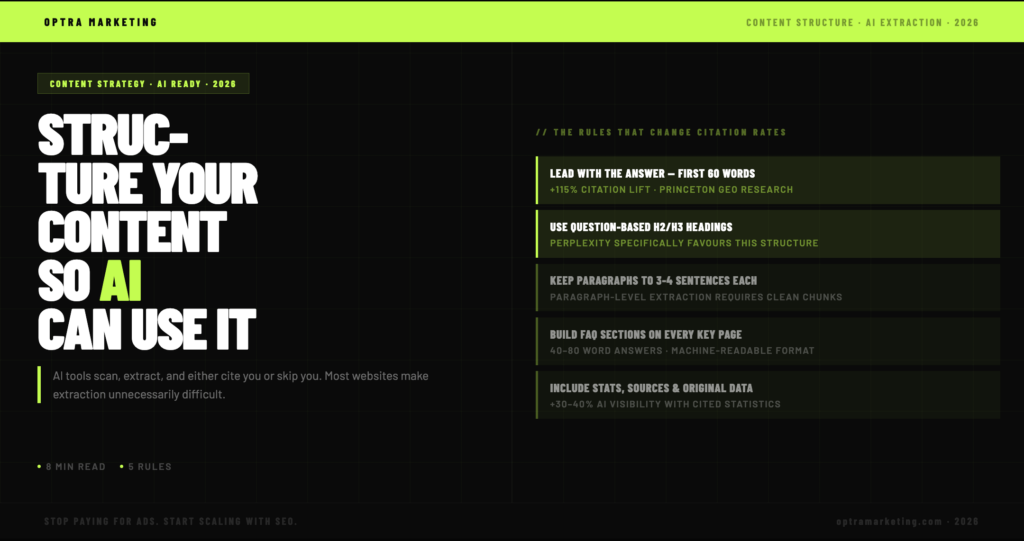
AI tools do not read your content the way a human does. They scan it, extract the most relevant pieces, evaluate whether those pieces are trustworthy, and either cite them or move on. Most website content is written in a way that makes this process unnecessarily difficult, which is why most businesses get skipped.
The good news: learning how to structure content for AI search is not a completely different skill set. It is a cleaner, more disciplined version of writing for humans. Here is exactly what AI-friendly content looks like in practice.
Start With the Answer, Not the Build-Up
The single most impactful change to your content structure for AI is moving the answer to the top of every page and every section. AI tools weight opening content heavily when deciding what to cite: analysis of ChatGPT citations found that around 44% come from the first third of a page. If your answer lives in paragraph nine, it is statistically far less likely to be extracted.
In practice, the first paragraph of every important page should answer the core question that page is built around. Not tease the answer. Not build up to it. State it clearly in 40 to 60 words as a direct answer, then expand with supporting detail below. This works equally well for humans, who appreciate not having to hunt for the point, and for AI engines, which extract the opening passage first.
Use Headings That Match Real Questions
Your H2 and H3 headings do two jobs simultaneously. They help human readers navigate the page, and they signal to AI tools exactly what question each section answers. Headings are the backbone of your content hierarchy, and AI retrieval systems lean on them hard.
A heading like “Our Approach” tells an AI engine nothing useful. A heading like “How Long Does Roof Replacement Take?” tells it exactly which search queries that section is relevant to. Engines with live retrieval, Perplexity especially, favour pages with structured H2 and H3 headings organized around specific questions.
Rewrite your headings to reflect the actual questions your customers ask. This applies to service pages as much as blog posts. A plumbing service page should carry headings like “What Does Emergency Plumbing Cost?” and “How Quickly Can a Plumber Arrive?” rather than generic ones like “Our Services” and “Why Choose Us.”
Keep Paragraphs Short and Self-Contained
AI tools extract content at the paragraph level, which makes paragraph length a structural decision, not a style preference. A paragraph that contains one clear idea is far easier to extract cleanly than a paragraph that meanders through three related points.
Keep most paragraphs to three or four sentences, each making a single point completely. This is not a constraint on depth. A page can be genuinely comprehensive while keeping individual paragraphs tight. It is a discipline that makes every paragraph extractable on its own, which is exactly how AI engines consume it.
Clean, semantic HTML supports the same goal. Proper heading tags, real paragraph elements, and marked-up lists give AI systems an unambiguous map of your page instead of forcing them to infer structure from visual layout.
Build a FAQ Section Into Every Key Page
FAQ sections directly signal answer-structured content to AI systems, and paired with FAQPage schema they are among the highest-impact structural elements you can add. But the schema only works if the underlying FAQ content is actually present and well-written.
Every service page and major blog post should include a FAQ section at or near the bottom. Write each answer to be self-contained, meaning it makes complete sense even if the question never appears above it. Keep answers between 40 and 80 words: shorter and the answer lacks substance, longer and it is likely to be truncated when extracted into an AI response.
Use Statistics, Sources, and Specific Claims
Generic statements get passed over in favour of specific, verifiable ones. “Local SEO can help your business grow” is not citable. A specific claim with an attributed source is.
The research here is clear. Princeton’s foundational GEO study found that adding relevant statistics improved AI visibility by 41% and quotations by 28%, while citing credible external sources improved visibility by up to 115% for lower-ranked pages. That last number matters most for small businesses: well-sourced content is the closest thing to a levelling mechanism in generative engine optimization, letting pages that would never rank first in Google still earn AI citations.
This does not mean footnoting every sentence. It means grounding your most important claims in real data and attributing them clearly. And where you have your own results or experience, use them. Original data, even from a single case study, is highly citable precisely because it cannot be found anywhere else.
Connect Your Pages to Each Other
AI tools evaluate topical authority, meaning they assess how comprehensively your website covers a subject. One strong page on a topic is less authoritative than a network of connected pages covering the topic from multiple angles.
This is the topic cluster model applied to AI visibility. A service page for local SEO for roofing, supported by posts on why roofing companies are not showing up on Google Maps, how roofing companies get more leads through local SEO, and a local SEO checklist for roofing contractors, creates a cluster of signals that reinforces authority across every page in the group.
Internal links between these pages are not just good for navigation. They tell both Google and AI tools that these pages belong together as one coherent, expert body of content, which is exactly how engines decide whether to structure content for AI Overviews citations around your domain or someone else’s.
What to Prioritise First
If you are starting from scratch, begin with your most important service pages. Rewrite the opening paragraph to lead with a clear, direct answer. Rewrite headings to reflect real questions. Tighten paragraph length. Add a FAQ section. Then move to your blog posts and apply the same principles.
This is not a one-time project. Every new piece of content you publish should follow this structure from day one, because retrofitting is always more expensive than building it right.
How Optra Marketing Can Help
Content structure is the area where small changes to existing pages often produce the fastest results. At Optra Marketing we audit your pages for structural gaps, rewrite openings and headings where needed, build FAQ sections into your key service pages, and implement the schema that makes that structure machine-readable.
If you are producing content regularly but not seeing it cited or ranked, structure is usually the first place we look. A free audit will tell you exactly which pages have structural gaps and what fixing them would look like.
