
How to Improve Your Local SEO Click-Through Rate
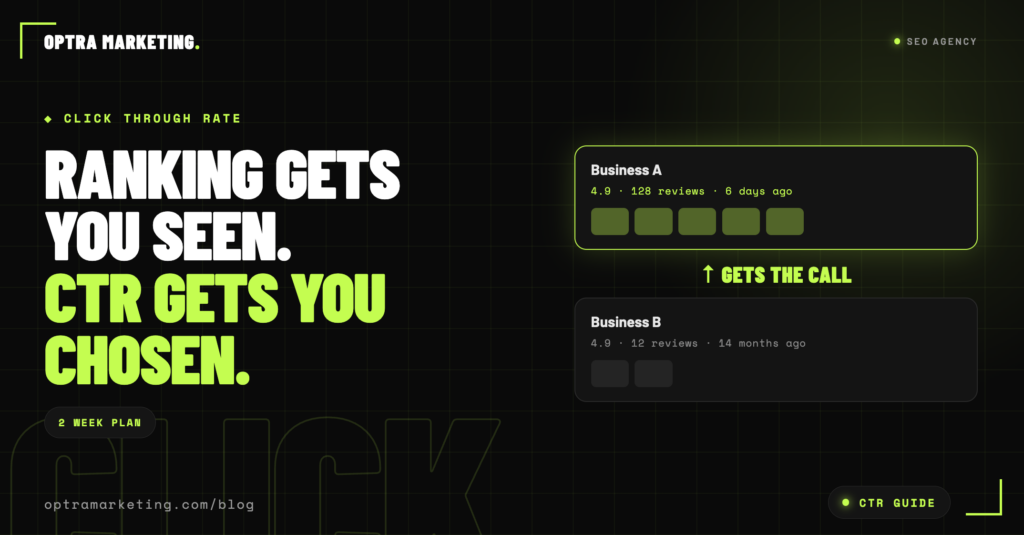
Two businesses sit next to each other in the Map Pack.
One gets most of the calls.
Position explains part of that, but not all of it, and often not most of it. Click-through rate is the gap between being visible and being chosen, and it is one of the few areas of local SEO where you can produce a meaningful improvement in a fortnight rather than a quarter.
Why CTR matters more in local search than anywhere else
In standard organic results, the searcher sees a title and a description. In local results they see a full comparison interface: star rating, review count, photograph, category, distance, opening status, and a call button.
That means the decision is being made on the results page itself, before anyone visits your website. It also means you have far more surface to influence than a title tag.
There is a second effect worth understanding, and worth being precise about. Engagement signals such as clicks, calls, and direction requests are observable behaviour that plausibly feeds back into how Google treats a listing, though Google has not confirmed CTR as a direct ranking factor. Treat CTR primarily as a conversion lever, exactly as described below, with any ranking benefit as a secondary, unconfirmed bonus rather than the reason to do this work.
What people actually compare
When someone looks at three Map Pack listings, they scan in roughly this order:
- Star rating and review count together. A 4.9 with 12 reviews reads differently from a 4.6 with 340
- The thumbnail photograph
- Category, checking you do the specific thing they need
- Distance and opening status
- Price indicator, where the category shows one
You can influence all five.
The levers, in order of impact
1. Review count and rating
This is the dominant factor and there are no shortcuts to it.
Two practical notes. First, a perfect five with very few reviews is often less persuasive than a 4.7 with many, because it reads as a small sample rather than a proven business. Second, recency matters to a human reader as much as to Google. A profile whose most recent review is fourteen months old reads as a business in decline.
What to do: build the request into your job completion process so it happens by default. Ask in person at the point of satisfaction, then follow up with a direct link. Never buy or incentivise.
2. Your review replies
Prospective customers read these, particularly on negative reviews. A measured, specific, non-defensive reply to a complaint frequently converts better than the complaint costs you.
Reply to positive reviews too. It takes a minute and it signals an actively managed business.
3. Photographs
Your thumbnail is the first visual comparison a searcher makes.
- Use real photographs. Stock imagery is recognisable and it undermines trust in a trades context
- Show the work, not just the logo. Completed jobs, vehicles, equipment, the team
- Show people. Faces outperform buildings for service businesses
- Keep adding them. A profile with recent photographs reads as active
- Get the quality right on the primary image specifically, since it does the most work
4. Category accuracy
A searcher checking whether you do the specific thing they need is checking your category. A roofing specialist listed under a general contracting category loses clicks to a competitor whose category matches the search exactly.
5. Business description and services
These appear when someone expands your listing, which is precisely the moment of decision. Vague descriptions lose to specific ones. List services individually with real descriptions rather than a single catch-all entry.
6. Opening hours and status
“Open now” filtering removes closed businesses from consideration entirely for a large share of local searches. Wrong hours cost you visibility you already earned.
Keep holiday hours updated. A profile showing open when you are closed produces a wasted call and a poor review.
7. Posts and Q&A
Both appear in the expanded listing. Posts show recent activity. Q&A answers objections at the point of decision, which is why seeding the questions customers genuinely ask is worth doing rather than waiting for them to arrive.
8. Attributes
Category-dependent, and underused. Accessibility, payment methods, appointment options, emergency availability, service guarantees. Any of these can be the deciding detail for a specific searcher.
Organic results: the other half
Below the Map Pack, your website listing is competing on title, description, URL, and any rich results you have earned.
- Titles should lead with the service and the location, and read like a human wrote them. Keyword-stuffed titles underperform even when they rank
- Meta descriptions do not affect ranking but they do affect clicks. Write them as a reason to click rather than a summary
- Review and rating structured data can still produce a star display in your organic result, which increases the visual footprint of your listing. FAQ structured data no longer produces a rich result in Google Search as of May 2026, Google retired it entirely, so it’s no longer a CTR lever even though the markup remains valid to keep. See our fuller breakdown of what schema markup actually does
- URLs that are short and readable outperform long parameterised ones
How to measure it
Your Google Business Profile insights give you the numbers directly. Track monthly:
- Views, split by search and maps
- Calls
- Direction requests
- Website clicks
- Messages
The ratio of calls to views is your practical CTR. If views are climbing and calls are flat, your ranking work is landing and your selection stage is failing, which points squarely at reviews, photographs, and completeness. For the fuller set of ranking levers this sits alongside, see how to get more calls from Google Maps.
For organic listings, Search Console gives you impressions, clicks, and CTR per page and per query. Pages ranking in the top five with a low CTR are the fastest wins available on the site.
A two-week improvement plan
Week one:
- Replace the primary photograph with a strong real image
- Add ten to fifteen genuine photographs of work, team, and vehicles
- Verify categories against the top three ranking competitors
- Check hours, including holidays
- Complete every service with an individual description
- Rewrite the business description in plain language
Week two:
- Reply to every unanswered review
- Seed and answer six to eight real customer questions in Q&A
- Set up a repeatable review request process
- Publish a post, and schedule weekly
- Rewrite titles and meta descriptions on your top five ranking pages
None of that requires a specialist and all of it affects whether you get chosen.
Frequently asked questions
What is a good click-through rate in local search?
There is no single benchmark, because it varies enormously by category, intent, and position. The useful comparison is your own trend: whether calls and website clicks are rising in proportion to views, month over month.
Does CTR affect local rankings?
Engagement with a listing is observable behaviour, and a result that is consistently chosen is behaving like a relevant one, though Google has not confirmed CTR as a direct ranking input. Treat CTR primarily as a conversion lever, with any ranking benefit as an unconfirmed secondary gain.
Why do I rank first but get fewer calls than the business below me?
Almost always reviews, photographs, or category mismatch. Position gets you seen. The comparison on the results page decides who gets called, and a competitor with more recent reviews and real photographs will win it.
How many photos should my Google Business Profile have?
There is no target, but thin profiles lose to rich ones. Aim for genuine coverage of your team, vehicles, equipment, premises where relevant, and completed work, and keep adding as you complete jobs.
Do meta descriptions affect local SEO?
Not rankings, but they affect whether people click your organic listing, which affects the traffic you get from the ranking you already have. They are among the fastest improvements available on an existing page.
Should I reply to negative reviews?
Yes, always. Prospects read the negative reviews specifically, and a calm, specific, non-defensive reply frequently converts better than the review costs you. Silence reads worse than the complaint.
How quickly can CTR improvements show up?
Faster than ranking work. Photographs, hours, categories, descriptions, and review replies can be fixed in a fortnight, and their effect on calls appears in your profile insights within weeks.
How Optra Marketing can help
Click-through work sits inside our Google Business Profile optimisation pillar, alongside weekly posts, Q and A seeding, review strategy, and geo-tagged imagery. It is one of the parts of local SEO that produces visible movement quickly, which makes it a sensible place to start while the slower ranking and authority work builds underneath.
It also connects to our landing page work, because a click that arrives on a page built to convert is worth considerably more than one that lands on a homepage.
Every strategy is built from scratch for the specific business and market. You work directly with the SEO team, plans are month to month with no lock-in, and if rankings have not improved in 90 days we keep working free.
Book a free strategy call with Optra Marketing.
