
SEO Statistics Every Business Owner Should Know in 2026
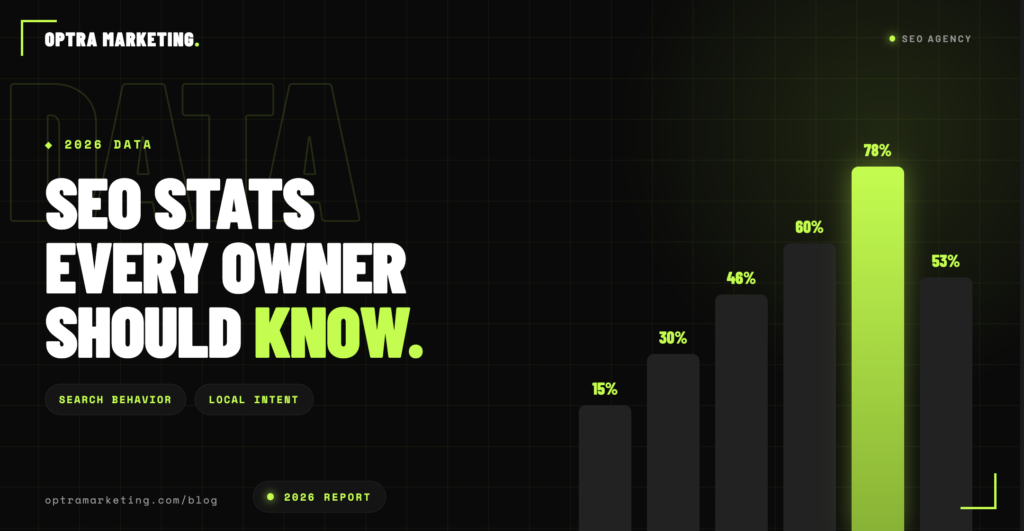
Most SEO statistics you find online are outdated, misleading, or both. Half cite studies from 2019 that no longer reflect how search works. The other half are marketing copy dressed up as data.
Below are the SEO statistics that actually matter for business owners in 2026, drawn from current industry data. Every number reflects how customers find, evaluate, and choose local businesses right now. If your marketing decisions rest on old assumptions about search, these stats will change how you allocate budget.
Key takeaways:
- Nearly half of all Google searches have local intent, and local searchers buy fast
- The top 3 local pack positions capture 60 percent of clicks: everything else is a cliff
- Reviews, mobile speed, and Google Business Profile optimization are the levers that move rankings
- AI search is no longer optional: AI Overviews now appear on nearly half of results pages
Local Search Statistics for 2026
1. 46% of all Google searches have local intent. Customers looking for products and services near them account for nearly half of all searches. This is why local SEO has become the single highest-ROI marketing channel for local businesses.
2. 78% of local mobile searches result in an offline purchase within 24 hours. Local search intent is not casual browsing. It is buying behavior. When someone searches for a local business, they are typically ready to purchase.
3. “Near me” searches have grown over 500% in the past decade. Voice search, mobile behavior, and evolving consumer expectations continue to concentrate demand into hyper-local queries.
4. 60% of local pack clicks go to the top 3 results. If your business is not in the top 3 of Google Maps for the searches your customers use, you capture almost none of the available local demand.
5. Position 4 in the local pack receives less than 10% of the click volume of position 1. The gap between winning the local pack and being just outside it is not incremental. It is a cliff.
Google Business Profile Statistics
6. A fully optimized Google Business Profile can generate up to 7x more clicks than an unoptimized one. The gap between businesses that treat their profile seriously and those that let it sit dormant is enormous.
7. Profiles with photos receive 42% more requests for directions. Photo activity is a small effort with a large local pack ranking effect.
8. Businesses that respond to reviews are 30% more likely to be viewed as trustworthy. Review response rate is also a local pack ranking signal, so responding delivers both direct trust and indirect ranking benefit.
9. 64% of consumers use Google Business Profile to find contact details for a local business. Your profile is not a supplemental listing. For most local customers, it is the primary way they find your phone number.
10. Top 3 local pack businesses typically have 80 to 200 reviews. If your review count sits below this range for your market, reviews are almost certainly what is blocking you from the top 3.
Mobile Search Statistics
11. 63% of all Google searches happen on mobile devices. Desktop-first design has been outdated for years. A local business without a fast, well-designed mobile site is filtering out most of its available search demand.
12. 53% of mobile users abandon a page that takes longer than 3 seconds to load. Page speed is not a nice-to-have. It is a filter for whether visitors ever see your content at all.
13. Mobile page speed is a direct ranking factor for local pack results. Google’s Core Web Vitals thresholds have effectively excluded slow mobile sites from top rankings in competitive markets.
14. 76% of people who search for something nearby on mobile visit a related business within a day. Local mobile search converts to foot traffic and phone calls at extremely high rates compared to other channels.
Online Review and Reputation Statistics
15. 93% of consumers say online reviews influence their purchasing decisions. Reviews are not vanity metrics. They directly determine whether customers who see your business choose to call.
16. Consumers read an average of 10 reviews before trusting a business. Businesses with only 5 or 10 reviews lose customers who leave no trace behind. The customer simply moves on to a business with more social proof.
17. A one-star increase in rating can lead to a 5 to 9% increase in revenue. Below 4.0 stars, every additional star fraction is significant. Above 4.5, additional fractions matter less.
18. 88% of consumers trust online reviews as much as personal recommendations. This is why systematic review acquisition has become non-negotiable for competitive local rankings.
Content and Search Behavior Statistics
19. Long-form content over 1,500 words receives 77% more backlinks than shorter posts. Depth still matters for organic rankings, but only when it serves the reader. Long thin content still fails.
20. Google processes more than 8.5 billion searches per day. At this scale, SEO is not optional for businesses that want to be findable. The alternative is invisibility.
21. 15% of daily Google searches are queries Google has never seen before. Search behavior evolves constantly, which is why static SEO strategies decay and continuous execution matters.
AI Search Statistics for 2026
22. Google’s AI Overviews appear on approximately 47% of search results pages. How customers see search results has shifted meaningfully in the last 18 months. Businesses ignoring AI search are already behind.
23. Roughly 30% of consumers now use AI tools like ChatGPT or Perplexity to research local businesses. AI search visibility has moved from optional to necessary for businesses that want to remain fully findable in 2026.
24. AI-generated answers cite an average of 3 to 5 source websites per response. Being one of those sources is now a legitimate SEO goal, and the fundamentals that earn traditional rankings also produce AI citations.
SEO ROI and Business Impact Statistics
25. SEO generates 1,000% more traffic than paid social media alone. Organic search is the highest-scale, longest-tail marketing channel available.
26. Average Google Ads cost per click has risen over 30% in three years across most local categories. As paid search gets more expensive, the relative ROI of organic SEO keeps increasing.
27. Companies that blog receive 55% more website visitors than those that do not. Content, done properly, remains one of the most reliable long-term traffic drivers.
28. A well-executed 90-day local SEO campaign produces measurable ranking improvement for most local businesses. Real SEO does not take a year to show results. If you are 90 days in with no measurable movement, something is wrong.
What These SEO Statistics Mean for Your Business
The pattern is consistent. Local search is the largest revenue-driving marketing channel available to most local businesses in 2026. The gap between businesses that execute properly and those that do not is enormous. And the fundamentals that produce results are consistent and repeatable.
The businesses winning the local pack in every US market share the same practices: optimized Google Business Profiles, active review acquisition, location-specific pages, fast mobile sites, clean citations, and consistent execution over months and quarters, not weeks.
How Optra Marketing Turns These Statistics Into Client Results
Every strategy we build starts from the numbers. Not vanity metrics, but the statistics that actually predict revenue growth for local businesses:
- Google Business Profile optimization first, because it drives the local pack rankings that capture 60 percent of clicks
- Review acquisition designed to close the gap to the 80 to 200 review range where top 3 businesses live
- Mobile page speed before content, because 53 percent of mobile users leave slow sites
- Location page architecture built for the 46 percent of searches with local intent
- AI search visibility from day one, as AI Overviews appear on nearly half of results
- A written 90-day guarantee, because well-executed SEO should produce measurable results in that window
- Transparent pricing from $699 per month with no long-term contracts
For a look at where these statistics show up in real client work, our guide on real local SEO results and what 6 months of consistent SEO can do covers the specific ranking and revenue improvements these numbers predict.
FAQs
Are these SEO statistics still accurate in 2026?
Yes. These statistics reflect current 2026 data on how search works, how customers behave, and how local businesses perform in Google’s results. Older statistics from 2019 and 2020 no longer reflect current mobile behavior, AI search prevalence, or Google Business Profile weighting.
Which SEO statistic matters most for a local business?
The top 3 local pack statistic. If you are not in the top 3 for your primary keywords, you are missing the majority of your available local demand. Every other optimization supports this outcome.
Do local businesses need to worry about AI search statistics?
Yes, more than most agencies suggest. AI adoption for local business research is growing fast, and businesses that ignore it will be behind by 2027. The good news: the fundamentals that produce traditional rankings also produce AI citations, so proper SEO covers both.
How much of my marketing budget should go to SEO?
Given the ROI difference between SEO and paid channels, most local businesses under-invest. Allocating 30 to 60 percent of digital marketing budget to organic search is reasonable for businesses whose customers come from local searches.
Why do SEO statistics change year to year?
Search behavior, Google’s algorithms, and consumer expectations all evolve. This is why static SEO strategies decay and continuous execution matters. What was true in 2020 is not fully true in 2026.
The Bottom Line
The SEO statistics of 2026 tell one consistent story. Local search is the highest-ROI marketing channel available to local businesses. The businesses that execute properly capture the majority of available demand. The businesses that do not are effectively invisible to their potential customers.
Book a free audit and we will show you exactly where your business stands against these statistics, what your gap to the top 3 looks like, and what your first 90 days of closing that gap would look like.
