
Why You Show Up in One City but Nowhere in the Next One Over
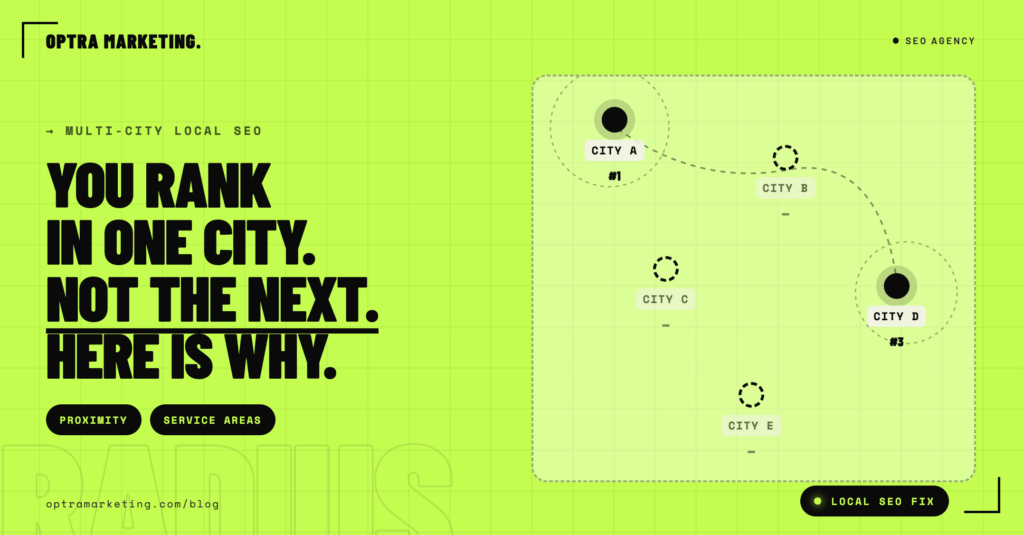
Type your service plus your hometown into Google. You appear. Top 3 in the map pack. Everything looks good.
Type the exact same service plus the neighboring city where you also serve customers. Nothing. Or worse, competitors sitting in local pack positions you should be holding because you actively serve customers there every week.
If you show up in one city but not the next one over, you have hit one of the most common walls in local business SEO. It is a specific problem with specific causes and a specific fix. Almost every multi-city local business runs into it. Most of them stay stuck for years because their SEO strategy was never built to handle it in the first place.
Here is what is actually happening and how to fix it.
Google’s Local Ranking Algorithm Runs City by City
The first thing to understand: Google does not rank businesses. Google ranks businesses in relation to specific searches from specific locations.
When someone searches “plumber” from downtown Chicago, Google runs a local ranking calculation to decide which businesses to show. The three most relevant businesses to that search from that location appear in the local pack.
When someone in a suburb 20 miles away searches the same “plumber,” Google runs a different local ranking calculation with different signals. Different businesses may be more or less relevant. The suburb’s local pack may not include any of the same businesses as the downtown local pack.
Your business does not have a single local ranking. It has a separate local ranking for every city and neighborhood it could theoretically be relevant to. That is why you can dominate your primary city and be invisible three miles away.
Reason 1: Your Google Business Profile Only Signals Relevance to Your Primary Location
Your Google Business Profile has a single physical address. That address anchors your relevance to Google’s local ranking algorithm. Businesses whose primary address is close to the searcher are much more likely to appear in that search’s local pack.
If your Google Business Profile address is in the middle of Chicago, you have very strong relevance signals for searches originating in Chicago. Your relevance signals to searches originating in the western suburbs are much weaker even though you actively serve those suburbs.
This is why service-area businesses often struggle to rank outside their physical location. The physical address anchors ranking in ways your service radius does not.
Fix: your Google Business Profile service area configuration needs to be complete and specific. List every city, town, and neighborhood you actually serve. But be aware that service area coverage helps somewhat but does not fully overcome the physical address anchor. Which is why the next reason is often bigger.
Reason 2: Your Website Has No Content About the Other Cities
Google’s local ranking algorithm looks at more than the Google Business Profile. It also looks at your website’s content signals about specific locations.
If your website has a homepage that says “we serve Chicago and surrounding areas” but no dedicated pages about the surrounding areas, Google has almost no content-level signal that you are relevant to searches in those surrounding areas.
Meanwhile, competitors in those surrounding areas have dedicated pages about their specific cities, with local content, local photos, local reviews, and local schema. Their content-level signals for the surrounding areas are much stronger than yours. Even though you actively serve those areas, Google shows their businesses because Google’s signals about them are more concrete.
The specific fix: dedicated location pages for every city you serve. Not a shared “service areas” page listing 6 cities. Six separate pages, one for each city, each with genuine content about serving that city specifically.
Reason 3: You Have No Reviews or Citations From the Other Cities
Reviews and citations tied to specific locations are strong local relevance signals. A cleaning business with 40 reviews from customers who mention living in downtown Chicago has strong local signals for downtown. The same business with only 3 reviews from customers mentioning the western suburbs has weak local signals for the suburbs.
Same for citations. Local news mentions, local business directory listings, chamber of commerce mentions, and other authority signals tied to specific cities build up your local relevance to those cities’ searches.
Building this over time is slow but powerful. Every service-area review that mentions a specific city or neighborhood strengthens your rankings for that area. Every local citation in a specific city compounds. The businesses ranking in areas outside their physical location got there by systematically building these local relevance signals for years.
Reason 4: Competitors Physically Located in the Other Cities Have a Structural Advantage
If a plumbing business is physically located in the western suburbs, they have a natural relevance advantage for searches from those suburbs that you cannot fully replicate because you are not physically there.
This does not mean you cannot rank in those suburbs. It means you cannot rank there just by tweaking your Google Business Profile. You have to overcome the structural advantage through stronger website content, stronger reviews from customers in those areas, stronger citations from those cities’ local sources, and often higher review volume overall.
Understanding this reality helps set realistic expectations. Ranking in a neighboring city where a strong competitor is physically located takes 6 to 12 months of consistent work. Ranking in a neighboring city where no strong competitor exists can happen in 90 days.
Reason 5: Your Service Area Is Set Incorrectly
Google Business Profile lets you define specific cities and neighborhoods you serve. Many businesses either skip this or fill it in incorrectly.
Common mistakes we find on audits:
- Service area left blank or set to a single city when the business serves many
- Service area set too broadly (an entire state or multiple states) which dilutes ranking relevance
- Service area cities listed with inconsistent spellings that Google cannot match to real place names
- Service area not updated as the business expanded
The fix is straightforward. Log into your Google Business Profile, go to service area configuration, and list every specific city and neighborhood you serve. Use the same spellings Google shows in search results.
This one change alone often produces modest ranking improvements in secondary cities within 30 to 60 days.
The Fix: Building a Multi-City Local Presence Systematically
Fixing the “one city yes, next city no” problem requires a systematic approach across five areas at once.
Step 1: Fix your Google Business Profile service area configuration. Fastest, easiest, produces early results.
Step 2: Build dedicated location pages for every city you serve. Each page should have genuine content about serving that specific city, including local landmarks, local neighborhoods you cover, local challenges customers in that city face, and specific case studies or examples.
Step 3: Start acquiring reviews from customers in secondary cities. Ask completed customers in those cities to mention their city in their review. City-specific review signals build up over months.
Step 4: Build citations in secondary cities. Local business directories for those specific cities, chamber of commerce listings, local sponsorships and event mentions.
Step 5: Consider physical location signals. For businesses with the budget, adding a satellite office or physical presence in a key secondary city (even a small one) can produce significant ranking benefits within 6 to 12 months.
How Optra Marketing Handles Multi-City Ranking
Multi-city expansion is one of the most common projects we take on. The fix requires disciplined execution across the fundamentals rather than any single silver bullet.
- Google Business Profile service area configuration audit and correction
- Dedicated location page architecture for every city you serve
- Location-specific content strategy including landmarks, neighborhoods, and local context
- Review acquisition strategy targeting customers in secondary cities
- Citation building in secondary cities’ local directories and business networks
- Local schema markup for each location page
- Monthly reporting broken out by city so you can see progress in each market
- Written 90 day guarantee on measurable ranking movement in secondary cities
- Transparent pricing from $699 per month with no long term contracts
For a broader look at how location-based ranking actually works, our guide on how to rank your business on Google Maps covers the underlying mechanics. Our detailed breakdown of local SEO mistakes that are costing your business leads covers the most common ranking blockers we find.
FAQs
How many cities can one Google Business Profile realistically rank in?
Most service-area businesses can rank strongly in their physical city plus 2 to 5 immediately adjacent cities with focused work. Ranking in cities more than 15 to 20 miles from the physical address gets progressively harder without either a satellite location or exceptionally strong content, reviews, and citations for those specific cities.
Should I create separate Google Business Profiles for each city?
No, unless you have a physical location in each city with different staff, hours, and phone numbers. Duplicate Google Business Profiles for the same business get flagged and suspended. One Google Business Profile per physical location is the rule.
How long does it take to rank in a new city?
For a city with weak competition, 60 to 120 days of systematic work usually produces movement. For a city with a strong physically-located competitor, 6 to 12 months is more realistic. The gap between reality and marketing promises here is where a lot of businesses get burned.
Do location pages actually work if I do not have a physical office in each city?
Yes. Well-built location pages produce meaningful ranking benefits even without physical presence. They cannot fully overcome a strong physically-located competitor, but they can compete against weaker competitors in cities where no dominant local business exists.
Should I include the city name in my Google Business Profile business name to help ranking?
No. This violates Google Business Profile guidelines and triggers suspensions. Use your actual business name only. Fight the ranking battle through other signals.
The Bottom Line
If you show up in one city but nowhere in the next one over, the fix is systematic multi-city local SEO rather than any single quick change. Location pages, service area configuration, city-specific reviews, and local citations compound over months into real ranking movement.
Book a free audit and we will show you exactly which cities you should be ranking in that you are not, what your ranking gap looks like, and what your first 90 days of expanding your visibility would look like.
