
Traditional SEO vs AI Search: What Actually Changed
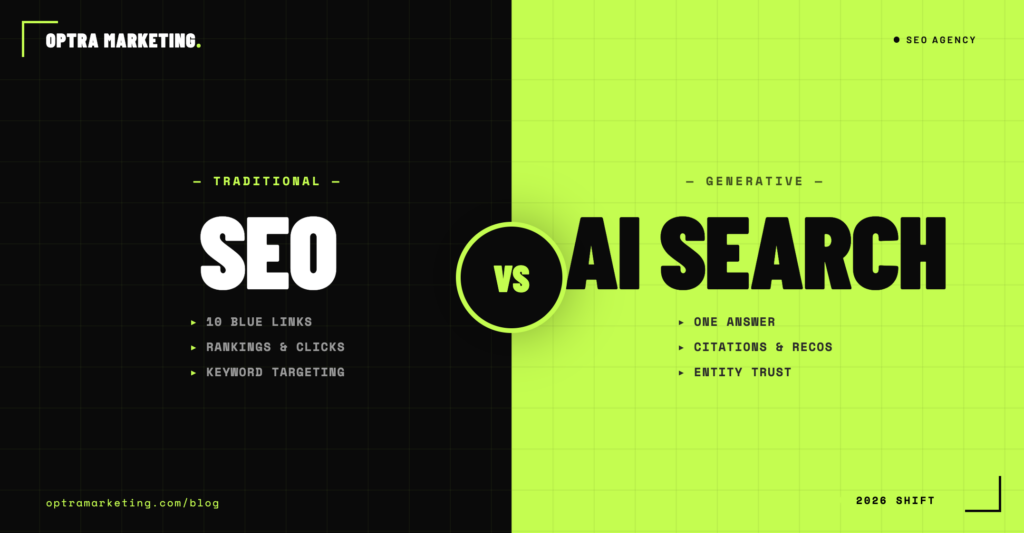
Two years ago, “AI search” barely existed as a real business concern. In 2026 it is one of the most-discussed and most-misunderstood shifts in how customers find businesses online.
You have probably heard several conflicting things. SEO is dead. SEO is more important than ever. AI Overviews are killing traffic. AI Overviews are irrelevant. GEO is the new SEO. GEO is a marketing term agencies invented to sell more services.
The truth about traditional SEO vs AI search sits between the extremes and matters for how you spend your marketing budget. Here is what actually changed, what did not, and what a local business owner should do differently in 2026.
What Traditional SEO Looked Like
Traditional SEO, as it operated from roughly 2010 through 2024, was built around a specific customer journey:
- Customer has a need
- Customer opens Google and types a query
- Google shows a list of blue link results (plus a local pack for local searches)
- Customer clicks one of the results
- Customer visits the website
- Customer decides whether to convert
Every SEO strategy was built around getting your business into position 1 to 3 of that results page. Rankings drove clicks. Clicks drove conversions.
The fundamentals of traditional SEO: keyword research, on-page optimization, backlinks, technical health, and (for local businesses) Google Business Profile optimization. Do these things well and you win the customer journey above.
For most search intents, this journey still describes how customers behave in 2026. Traditional SEO is not dead. It is still doing the majority of the work.
What Actually Changed With AI Search
AI search changed one specific part of the customer journey: what happens between step 3 (search results appear) and step 4 (customer clicks a result).
Google’s AI Overviews now appear on approximately 47 percent of search results pages. When they appear, they generate a summarized answer at the top of the page, often citing 3 to 5 source websites. For a significant portion of searches, customers now read the AI answer and get what they needed without clicking any website at all.
This is the “zero-click search” phenomenon. It is real and it is meaningful for certain types of searches.
Beyond Google, dedicated AI search tools like ChatGPT, Perplexity, Claude, and Gemini are also being used by a growing minority of customers to research businesses. Approximately 30 percent of consumers report using AI tools for local business research at least occasionally in 2026.
What this means: for informational and research queries, AI Overviews are compressing the customer journey and reducing website clicks. For high-intent buyer queries, the journey is mostly unchanged.
Which Searches AI Actually Affected
The impact of AI search is not uniform. Some search types have been dramatically affected. Others have been almost untouched.
Heavily affected searches:
- Informational queries (“what is HVAC,” “how does solar work”)
- Definitional queries (“what does SEO stand for”)
- Simple factual questions
- Long-tail research queries with clear factual answers
For these searches, AI Overviews often provide complete answers that eliminate the click.
Barely affected searches:
- High-intent local queries (“HVAC repair near me,” “plumber in Chicago”)
- Purchase intent queries (“buy office chair,” “book restaurant reservation”)
- Branded searches (“Optra Marketing”)
- Complex queries requiring provider comparison and evaluation
- Emergency or urgent searches
For these searches, customers still click through to businesses because they need to do something (call, book, purchase, hire) that an AI summary cannot complete for them.
For most local businesses, the majority of their revenue-driving traffic comes from the second category. AI search has meaningfully changed the customer journey for research queries. It has changed the customer journey for buyer queries much less.
What the AI Search Shift Actually Requires You to Do
If you run a local business, the shift toward AI search requires three specific adjustments to your SEO strategy. Not a full rebuild. Three adjustments.
Adjustment 1: Structure content so AI systems can use it
AI Overviews and dedicated AI search tools cite sources that present information clearly, use structured data, and directly answer specific questions. Content built for old SEO practices (keyword-stuffed, listicle-heavy, thin) does not get cited. Content built for actually answering questions does.
Practical version: write content that directly answers the question in the title, within the first 100 words, in plain language, with the facts organized so a machine can extract them. This makes your content more likely to be cited by AI systems AND easier for human readers to use. Win-win.
Adjustment 2: Build the underlying trust signals AI systems rely on
AI search systems weight the same signals that traditional Google rankings weight (backlinks, review count, business authority, content quality) but they use them differently. The businesses being cited by AI are almost always businesses that would also rank in traditional Google results.
Practical version: the same fundamentals that produce strong traditional SEO produce strong AI search visibility. This is why chasing “AI SEO” as a separate discipline from real SEO is usually a waste of budget. Nail the fundamentals and both surfaces improve together.
Adjustment 3: Maintain traditional SEO because most revenue-driving searches still go through it
Do not overweight AI search to the point that traditional SEO is neglected. For local businesses in 2026, traditional local pack rankings and organic rankings still drive the majority of calls and revenue. AI search is important. It is not more important than the traditional fundamentals.
What Agencies Get Wrong About AI Search
Two common mistakes are showing up across the agency landscape in 2026.
Mistake 1: Selling “AI SEO” or “GEO” as a separate premium service
Most of what agencies package as AI SEO is either traditional SEO with a new name, or thin additional deliverables designed to justify a higher retainer. If your agency is trying to sell you AI SEO for $2,000 per month on top of your existing SEO, ask what is actually different in the deliverables. Usually it is very little.
Mistake 2: Ignoring AI search entirely
The opposite mistake. Some agencies pretend AI search does not exist because they do not know how to think about it. Both extremes are wrong. AI search matters. It should be integrated into your standard SEO strategy rather than either dismissed or oversold.
The right approach: your SEO agency should treat AI search as part of the standard 2026 SEO fundamentals rather than as a separate premium offering. If they charge extra for it or ignore it entirely, both are signals.
How Optra Marketing Integrates AI Search Into Traditional SEO
We built our engagement structure around the reality that traditional SEO and AI search share most of their fundamentals. Instead of billing them separately, we integrate:
- Content built for both traditional rankings and AI citation, structured to answer specific questions
- Structured data and schema markup that helps both Google’s ranking algorithm and AI parsing systems
- Traditional local pack optimization prioritized because it still drives the majority of local business revenue
- Backlink and authority building that supports both traditional ranking and AI citation
- Google Business Profile optimization that improves both local pack visibility and AI local business recommendations
- AI search visibility tracking included in monthly reporting as standard
- Written 90 day guarantee on measurable ranking and revenue improvement
- Transparent pricing from $699 per month with no AI-search upcharge
For a deeper look at how AI search fits into the broader 2026 SEO landscape, our guide on how AI search works and why it matters for your business covers the mechanics. Our detailed breakdown of GEO vs SEO and what local service businesses need covers the specific applications for local businesses.
FAQs
Is SEO still relevant with AI search?
Yes. Traditional SEO still drives the majority of local business revenue. AI search has changed the customer journey for research queries but not for most buyer-intent queries. Both matter and the fundamentals for both are similar.
Should I hire a separate agency for AI SEO?
No. AI search visibility should be part of your regular SEO strategy, not a separate service. Any agency that treats it as a premium add-on is usually charging you twice for overlapping work.
How much of my SEO budget should focus on AI search specifically?
For most local businesses, AI-specific optimization is roughly 10 to 20 percent of the total effort. The other 80 to 90 percent is traditional SEO fundamentals that also feed into AI search visibility. If an agency is selling you 50 percent AI SEO focus, they are overselling.
Do AI search tools like ChatGPT and Perplexity actually drive customers?
Some, and growing. For most local businesses in 2026, AI-tool referrals are meaningful but small compared to traditional Google search. That will likely shift over the next few years. Getting your business cited in AI answers now is a good long-term investment even if the immediate traffic is small.
Will AI search kill SEO eventually?
Unlikely. Customer intent, buyer behavior, and the need for businesses to be findable will not go away. The channels will evolve. Businesses that optimize for how customers actually find and hire providers will keep winning regardless of the exact interface.
The Bottom Line
Traditional SEO vs AI search is a false binary. The customer journey has shifted for some search types but the fundamentals of local business SEO remain largely intact. Businesses that overreact to AI search hype waste budget. Businesses that ignore AI search get slowly left behind. The right answer is integrating AI search into a strong traditional SEO strategy.
Book a free audit and we will show you exactly where your business sits in both traditional search and AI search, what the gap looks like, and what your first 90 days of closing both would look like.
