
SEO for a New Website: What to Do in the First 90 Days
A new website starts with no history, no links and no track record with Google. That’s not a reason for discouragement, but it is a reason to be deliberate. When it comes to SEO for a new website, what you do in the first three months shapes how quickly the site starts bringing in business.
This plan is written for local service businesses launching a new site, whether it’s a brand-new company or an established business moving to a new domain or platform. It focuses on the work that pays off fastest.
Set Expectations First
New websites rarely rank for competitive terms in their first few weeks. Google needs time to crawl the site, understand what it’s about and see signals that others trust it. For local businesses, the map results often move before organic rankings do, because a well-optimized Business Profile can gain traction faster than a new domain.
Most businesses see early movement within 60 to 90 days, with stronger results building over the following months. Knowing how long local SEO takes to show results helps you judge progress fairly.
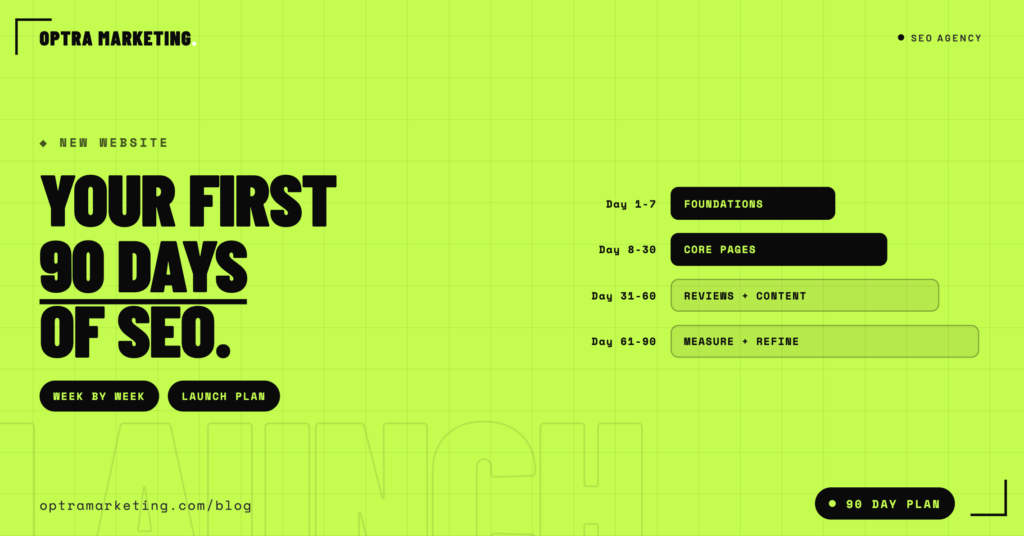
Days 1 to 7: Foundations
- Verify the site in Google Search Console and submit your XML sitemap.
- Install Google Analytics and set up conversion tracking for calls and form submissions.
- Check indexing settings. Make sure no development setting or leftover noindex tag is blocking search engines.
- Confirm one domain version. All variations should redirect to a single https address.
- Link your website from your Google Business Profile, or set the profile up and complete Business Profile verification if you don’t have one yet.
- Request indexing for your homepage and main service pages.
Days 8 to 30: Core Pages and Local Signals
This is where most of the ranking potential is built.
Build a Page for Every Core Service
Create a dedicated page for every core service. Each should explain what the service involves, the process, cost factors, service areas and FAQs, with your own photos. Short, thin service pages rarely rank, so give each one real substance from the start. Then build pages for your main service areas, focusing on the towns or neighborhoods that matter most rather than every possible location.
Strengthen Your Local Signals
Complete every section of your Google Business Profile, including categories, services, hours, photos and description. Then list your business consistently on the major directories, such as Bing, Apple Maps, Yelp and relevant industry sites. Building local citations early on gives Google confidence in your business details.
Add Schema and Check Your Details
Add LocalBusiness schema to your homepage and make sure your name, address and phone number match everywhere.
Days 31 to 60: Trust and Content
Start a Steady Review Process
Ask every satisfied customer, by text or email, with a direct link to your review form. A consistent flow of reviews from the start is worth more than a burst later, and the habit is the most reliable way to build up your Google reviews over time.
Publish Helpful Content
Answer real customer questions: costs, timelines, how to choose a provider, seasonal maintenance. Each piece should link naturally to the relevant service page.
Look for Early Link Opportunities
Local associations, suppliers, sponsorships, community organizations and local news coverage are all realistic sources of relevant links for a new business.
Days 61 to 90: Measure and Refine
By now, Search Console will show which searches your pages appear for. Look for pages getting impressions but few clicks, and rewrite their title tags and descriptions. Find queries where you rank on page two and strengthen the relevant pages. Check which pages bring in calls and forms, and build on them.
This is also the time to fix anything that isn’t being indexed, and to plan the next round of content and location pages based on real data rather than guesses.
New Website SEO Checklist: Mistakes to Avoid
A few shortcuts consistently slow new sites down. Launching dozens of near-identical city pages on day one spreads a young site too thin. Buying cheap directory links or bulk backlink packages can do lasting damage before the site has earned any trust. Changing URLs and page names repeatedly in the first months forces Google to keep relearning the site. And chasing broad, highly competitive terms too early leads to frustration, when specific service and neighborhood searches would bring in calls much sooner. Patience and consistency do more for a new site than any trick.
Frequently Asked Questions
How long does it take to rank a new website?
Indexing usually happens within days to weeks. Early ranking movement for local terms often appears within 60 to 90 days, and competitive positions typically take several months to build.
Is it worth buying an older domain to rank faster?
Rarely. An older domain’s history may include spam or unrelated content, and the benefit for a local business is usually small. Building a clean site with strong local signals is more reliable.
How many pages should a new site launch with?
Enough to cover every core service with its own page, plus your main service areas, about, contact and a homepage. Quality matters more than volume.
Should I start blogging right away?
Service pages come first, because they target the searches that bring in jobs. Once they’re in place, regular helpful content supports them and builds authority.
Is my Google Business Profile more important than my website at first?
For map visibility, the profile often has the quickest impact. But the two work together, and Google checks your website to confirm what your profile says.
Building It Right From Day One
Optra Marketing’s Starter plan was designed for precisely this stage, when a business is ready to build its online presence on solid ground. It bundles Google Business Profile setup and optimization, keyword research, on-page work for up to 10 core pages, monthly content, link building and a technical audit: the groundwork that decides how fast a new site starts winning searches.
Doing it properly from the outset means there are no shortcuts to unpick later. Every plan is month to month, so you can judge the early progress for yourself before committing further. Our local SEO team will build the plan around your services and service area, not a generic template. Book a free strategy call, and we’ll sketch out your first 90 days together.
