
Thin Content: Why Short Service Pages Don’t Rank
A lot of service business websites follow the same template. A homepage, an about page, and a services page with a heading and two sentences for each service. Perhaps a dozen location pages with the same paragraph and a different city name.
On paper, every service and area is covered. In Google, almost none of those pages rank. The reason is thin content, and it’s one of the most fixable problems a local business website can have.
What Thin Content Actually Means
Thin content isn’t defined by word count. A 200-word page can be perfectly useful if it fully answers a simple question. A 2,000-word page can be thin if it’s padded, generic or copied.
Google’s systems are built to reward pages that are genuinely helpful to people, and to demote pages that offer little original value. A thin page is one that doesn’t give a searcher a reason to choose it over the alternatives.
On local business sites, it usually looks like:
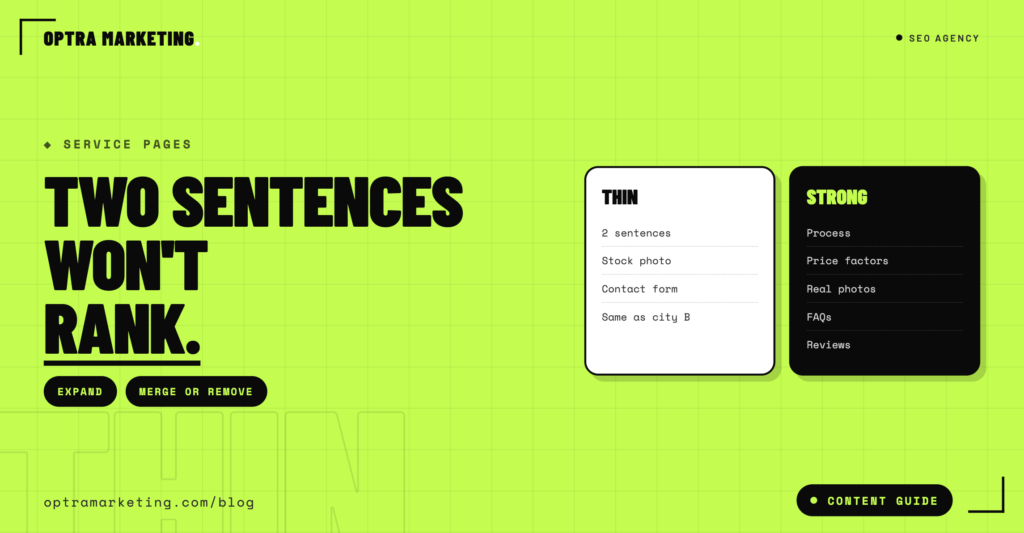
- service pages with a sentence or two and a contact form;
- city pages with identical text and a swapped place name;
- blog posts that restate general advice found everywhere;
- tag, category and archive pages with no content of their own;
- pages made mostly of stock photos and boilerplate.
Why Thin Content Holds You Back
When someone searches “bathroom remodel cost Denver,” Google looks for the page that best helps them make a decision. A page that says “We offer quality bathroom remodeling. Call today!” gives Google nothing to work with. A competitor’s page that explains typical cost ranges, timelines, materials and permit requirements in Denver will win almost every time.
Thin pages can also affect your site more broadly. When a large share of a site offers little value, Google tends to be more selective about crawling and indexing the rest of it, which is why so many thin pages end up labelled “Crawled – currently not indexed” in Search Console.
Thin vs. Strong: A Side-by-Side Example
Consider two pages for the same service. The thin version reads: “We provide water heater installation for homes and businesses. Our team is licensed and experienced. Contact us today for a free quote.” It’s accurate, but it could belong to any company in any city.
The strong version explains the difference between tank and tankless units, how long installation usually takes, what happens when an old unit needs removing, how local code affects venting, and which neighborhoods the team covers. It shows photos of recent installs and includes a review from a customer who switched to tankless. The second page answers the questions a homeowner is actually asking, and that’s exactly what Google is trying to find.
What Strong Service Page Content Includes
Think about what a customer needs to know before calling. A service page that ranks usually covers:
- what the service includes, and what it doesn’t;
- signs a customer needs it, in their own words;
- how the process works from first call to completion;
- the factors that affect price, with ranges where you can share them;
- typical timelines;
- the areas you serve for that service;
- photos of your own work, ideally before and after;
- reviews from customers who used that specific service;
- answers to common questions;
- a clear next step, such as booking or calling.
That isn’t padding. Every element helps a customer decide, and it naturally includes the details Google uses to understand relevance.
Fixing Thin Location Pages
Location pages need content that’s specific to the place. That might include neighborhoods you work in, the types of homes common in the area, local regulations or permit processes, climate issues that affect the work, and projects you’ve completed there. Reviews from customers in that area add credibility. Done properly, you end up with a genuinely unique landing page for each city rather than a stack of near-copies.
If you can’t say anything specific about a location, it may not need its own page yet. A smaller number of strong area pages beats dozens of weak ones.
Expand, Merge or Remove
Audit your thin pages and sort them into three groups. Pages targeting services or areas you want to grow should be expanded. Pages that overlap with each other should be merged into one stronger page, with a redirect from the old URL. Pages with no business value, such as empty tag archives, can be removed or given a noindex tag so they stay out of search.
Frequently Asked Questions
How many words should a service page have?
There’s no fixed number. Most service pages that rank well in competitive local markets cover the topic in enough depth that they end up running several hundred words or more, because answering a customer’s real questions takes that much space.
Can thin pages hurt my whole website?
They can contribute to it. In thin content SEO terms, if most of a site is thin, Google may treat the site as lower quality overall, which affects how readily new pages are crawled and ranked.
Can I reuse content across location pages?
Some shared content is fine, such as a paragraph about your warranty. But each page needs enough unique, local substance to stand on its own.
Should I delete thin blog posts?
Not automatically. Update posts that target useful topics, merge posts that overlap, and remove or redirect posts that serve no purpose.
Is AI-generated content thin by definition?
Not by definition, but generic AI content that repeats what’s already published tends to be thin, and AI-written blogs can pull down local rankings when they add nothing new. Google evaluates whether content is helpful and shows real expertise, regardless of how it was produced, which is why E-E-A-T matters more than ever.
From Thin Pages to Pages That Win Jobs
When we started working with a roofing contractor stuck at $20,000 a month, much of the effort went into replacing a few thin pages with properly built ones that answered what homeowners in their area were really asking. Within five months, the business was consistently passing $100,000 a month.
Both Optra Marketing plans come with a monthly content allowance that can go toward brand-new pages or toward reworking the ones already on your site, so thin content gets fixed instead of buried. Each piece follows a content strategy shaped by real customer searches and by what competing pages already cover. Book a free strategy call, and we’ll pinpoint the thinnest pages on your site and what each one needs.
