
How to Do a Local SEO Audit Yourself (Step by Step)
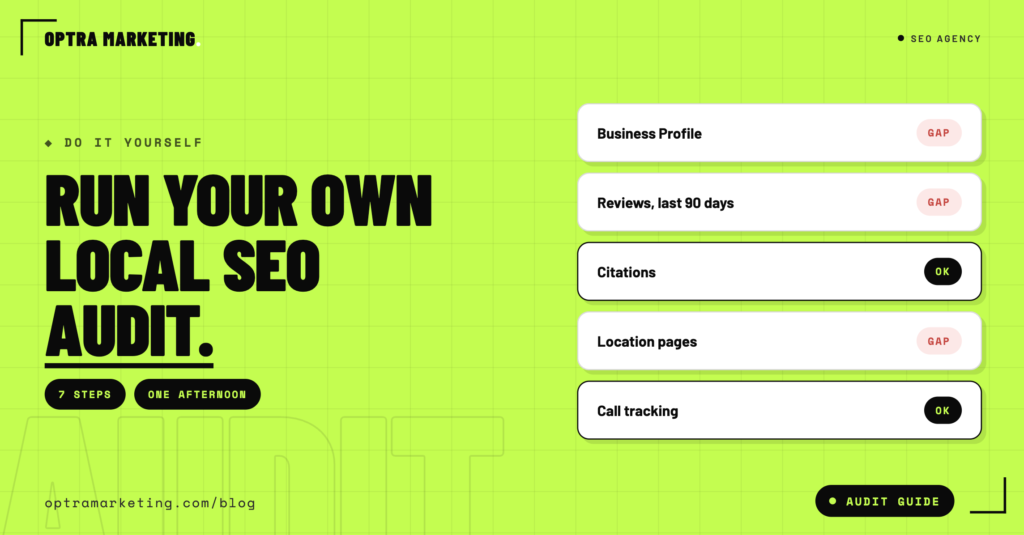
If competitors keep appearing above you in Google Maps, there’s a reason, and it’s usually findable in an afternoon. A local SEO audit looks at the specific signals Google uses to rank businesses in local results, compares yours with the businesses beating you, and shows you where the gaps are.
You don’t need expensive software to do it. You need a spreadsheet, a couple of free tools and an honest look at your online presence. Here’s how to work through it.
Step 1: Run a Google Business Profile Audit
Your profile is the most important local asset you have, so start here. Check each element against the businesses in the top three map results for your main service.
Primary Category
Is it the most specific one that describes your core service? Compare it with what the top-ranking competitors use.
Secondary Categories
Have you added every relevant category, without stretching into ones that don’t apply?
Services and Description
Are all your services listed, with clear descriptions?
Service Areas or Address
Is it accurate, and is a home address hidden if you travel to customers?
Hours, Phone and Website
Are they correct and consistent with your website?
Photos
Do you have recent photos of real work, your team and your vehicles, not just a logo?
Posts and Q&A
Is the profile active, or has it been untouched for months?
Step 2: Check Where You Actually Rank
Searching from your own office gives a distorted picture, because Google weights results by proximity. Ask customers or staff in different parts of your service area to search your main terms, or use a local rank grid tool that checks rankings from multiple points across your city.
It’s common to find that you rank in one city and vanish in the next, showing strongly near your address and fading a few miles out. That pattern tells you where location pages, reviews and citations need to work harder.
Step 3: Compare Reviews
For yourself and your top three competitors, note the total review count, average rating, how many reviews arrived in the last 90 days, and whether the owner replies, including how well they respond to negative reviews. Recency matters as much as volume. A competitor with fewer reviews but a steady monthly flow often outperforms a business with a large but stale review count.
Step 4: Review Your Citations
Search your business name and phone number together and look through the directory listings that appear. Your name, address and phone number should be identical everywhere: Google, Bing, Apple Maps, Yelp, the BBB, industry directories and your chamber of commerce. Old addresses, former phone numbers and duplicate listings all weaken trust in your data. Consistent citations across directories remain one of the foundations of map visibility.
Step 5: Assess Your Website’s Local Relevance
Google cross-checks your profile against your website. Look for:
- a dedicated page for each core service, not one page listing everything;
- pages for the main towns or neighborhoods you serve, each with genuinely local content;
- your name, address and phone number on every page, usually in the footer;
- LocalBusiness schema markup;
- title tags that name the service and location.
If your site ranks but your map listing doesn’t, or the other way around, the gap usually sits here. It’s the classic pattern when a website ranks but the Google Business Profile does not.
Step 6: Check the Technical Basics
Confirm your important pages are indexed in Google Search Console, load quickly on mobile, and don’t have duplicate versions. A local audit doesn’t need to go as deep as a full technical SEO checklist, but a blocked or slow service page undermines everything else.
Step 7: Check That You Can Measure Results
Finally, make sure you can tell what’s working. Is call tracking set up? Are form submissions recorded in Analytics? Can you see calls and website clicks in your Business Profile performance data? Without this, you can’t tell whether changes are bringing in more business.
Turning Your Local SEO Audit Checklist Into a Plan
You’ll likely end up with a long list. Prioritize anything that affects your Business Profile and reviews first, because those influence map rankings most directly. Then fix citation inconsistencies, then build out missing service and location pages. Once the big gaps are closed, work through the complete local SEO checklist to tighten everything else.
Frequently Asked Questions
How long does a local SEO audit take?
For a single-location business, a thorough audit takes three to five hours. Businesses running local SEO for multiple locations need longer, because each profile and location page should be checked separately.
What tools do I need?
Google Search Console, your Business Profile dashboard and a spreadsheet cover most of it. A local rank grid tool and a citation checker add useful detail, and many offer free trials.
How often should I audit my local SEO?
A full audit every six months is a good rhythm. Check your Business Profile and reviews monthly, since that’s where changes happen fastest.
How is a local SEO audit different from a regular SEO audit?
A regular audit focuses mostly on the website, covering much of what an SEO audit uncovers about a site’s health. A local audit adds the signals specific to map results: your Business Profile, reviews, citations, proximity and local relevance.
What should I fix first?
Usually the primary category, missing services, inconsistent contact details and a lack of recent reviews. These are quick to fix and often produce the fastest improvement in map rankings.
An Audit That Ends in a Plan, Not a PDF
A local SEO audit only earns its keep through what happens afterward. Ours doesn’t conclude with a 60-page report of warnings; it concludes with a short, ranked plan built for your specific market. We line you up against the businesses currently outranking you, explain in plain terms why each one is ahead, and lay out what it will take to overtake them.
On the Growth plan, that side-by-side comparison turns into ongoing competitor tracking within our local SEO work, so you can watch the gap narrow from one month to the next. Prefer to hand the legwork to specialists? Book a free strategy call, and we’ll walk through what your audit turns up together.
