
SEO Fundamentals That Still Matter in 2026
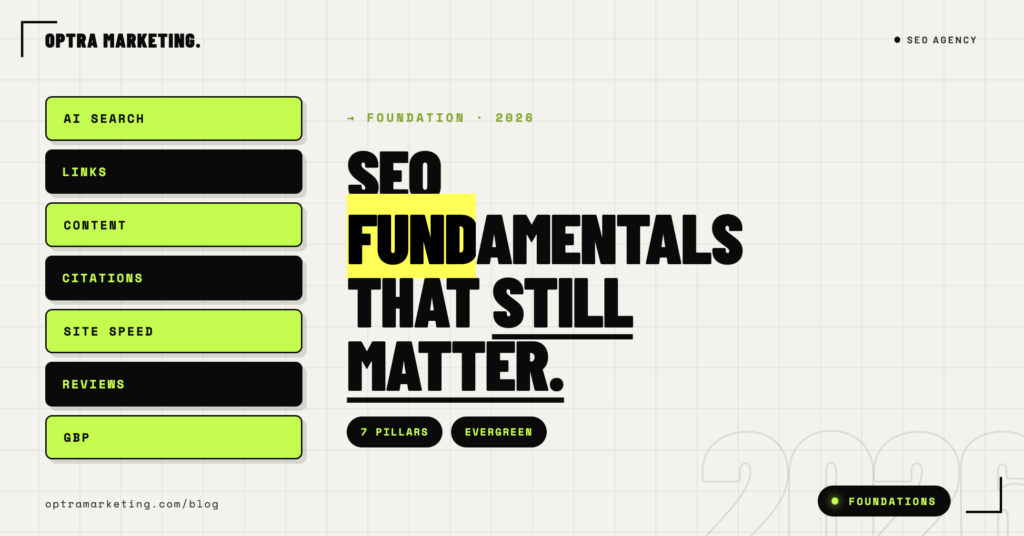
Every year someone announces that SEO is dead. Every year SEO gets more important.
What changes is the mix. Certain SEO fundamentals from 2016 are worthless in 2026. Others are more important than they have ever been. And a handful of newer factors have moved from optional to non-negotiable in the last 24 months.
If you are trying to figure out which SEO fundamentals in 2026 still deserve your time, budget, and attention, here is the honest breakdown: what still works, what stopped working, what replaced it, and how the local business SEO landscape has actually shifted.
Quick answer: The SEO fundamentals that matter in 2026 are Google Business Profile optimization, systematic review acquisition, location-specific pages, mobile site speed, clean citations, earned backlinks, deeper content over more content, and AI search visibility. Keyword stuffing, bulk citations, bought links, and high-volume thin content are dead.
1. Google Business Profile Optimization Is Now the Foundation
Ten years ago, your website was the foundation of your local SEO. In 2026, your Google Business Profile is.
For any local search with commercial intent (and 46 percent of all Google searches have local intent), the local pack sits above the organic results. Businesses in the top 3 of the local pack capture the majority of clicks. Businesses in positions 4 through 10 might as well not exist.
That makes Google Business Profile optimization the single highest-leverage SEO fundamental for local businesses. Every other SEO activity feeds into it or supports it. In 2026 that means:
- Primary category selected correctly (the single biggest map pack ranking factor)
- Secondary categories covering every service you offer
- Complete services list with descriptions for each
- Service areas defined for every location you cover
- Weekly Google Business Profile posts with real content and photos
- Q&A monitored and answered
- Attributes filled in completely
- Photos updated monthly
If your Google Business Profile is dormant, no amount of other SEO work will produce local pack rankings.
2. Real Reviews at Real Velocity
Reviews became a top-3 local ranking factor around 2020 and their weight has increased every year since. In 2026 they are non-negotiable.
Total review count matters. Recency matters more. Response rate matters. Star average matters within a band: the practical difference between 4.7 and 4.9 is small, but the difference between 4.2 and 4.7 is significant for both rankings and conversions.
The businesses winning local pack rankings in competitive 2026 markets run consistent review acquisition systems that produce 5 to 15 new reviews per month. Businesses relying on organic word-of-mouth cannot compete against systematic review generation.
If your review count sits at 20 while competitors sit at 80 plus, you have a fundamental SEO problem that no amount of technical or content work will overcome. Fix reviews first.
3. Location-Specific Pages Beat Generic Homepages
A generic homepage cannot rank for local searches across multiple cities. It has not been able to for years, but the gap widened significantly in 2026 as Google’s local ranking algorithm placed more weight on hyper-local relevance signals.
A plumbing business serving 6 cities needs 6 dedicated city pages, plus service pages for each major offering, plus combined pages for high-intent service and city combinations. That is not 6 pages. It is closer to 40.
The businesses winning local SEO in 2026 have built comprehensive location-specific page libraries: real content on each, real photos of real jobs in each location, real reviews from customers in each city, real local context a generic homepage cannot replicate.
If your website is one homepage trying to rank for everything, that is a fundamental SEO problem in 2026.
4. Mobile Site Speed Is a Ranking Filter, Not a Ranking Factor
Site speed used to be a subtle ranking factor. In 2026 it is a filter.
Google’s Core Web Vitals thresholds mean a mobile site loading slower than 2.5 seconds on Largest Contentful Paint is effectively excluded from top rankings in competitive markets. Not demoted. Excluded. The businesses filling the top 3 spots all pass Core Web Vitals. Yours has to as well.
This is one of the biggest silent SEO killers we see on audits: beautifully designed websites, comprehensive content, decent backlink profiles, all stuck outside the top 10 because mobile page speed is 6 to 8 seconds.
Fix site speed before doing any other SEO work. It is the single biggest bottleneck for most under-performing local businesses in 2026.
5. Citations Still Matter, but Quality Over Quantity
Building 500 low-quality citations was standard SEO practice a decade ago. In 2026 it is worse than useless. It is actively harmful.
What still works: a clean, consistent citation profile across the 30 to 50 directories Google actually references. Google Maps, Apple Maps, Bing Places, Yelp, Facebook, Better Business Bureau, and the industry-specific directories relevant to your business type. NAP (name, address, phone) consistent to the character across every one.
What does not work: bulk submission to hundreds of low-quality directories. This is the citation strategy cheap SEO agencies still sell in 2026, and it damages more than it helps. If your recent citation growth is 100 plus new directories from names you do not recognize, you have an over-optimization problem.
6. Backlinks Still Matter, but They Are Not the Whole Story
Backlinks remain a core ranking factor for organic results (though less so for map pack rankings). But the backlink playbook of the last decade is dead.
Dead in 2026: guest posts on random blogs, directory submissions, reciprocal linking, private blog networks, cheap “authority” link packages. All actively harmful.
What still works: earned backlinks from relevant, authoritative sources. Local media coverage. Industry publication mentions. Real relationships with businesses that link to you because you are worth linking to. Digital PR that gets your business referenced in stories journalists actually publish.
These are slower to build than the old link-buying tactics. They are also durable in a way bought links never were. If your SEO agency is buying links, they are damaging your long-term rankings even if the short-term reports look fine.
7. Content Quality Beats Content Volume
The volume-based content strategy of the 2010s (publish 10 to 20 posts per month, saturate the topic, wait for Google to rank them) is dead in 2026. Google’s Helpful Content update and subsequent algorithm shifts specifically target thin, generic content produced at high volume.
What ranks in 2026: fewer pieces of deeper, more useful, more specific content. A local plumbing business does not need 40 generic blog posts about pipe repair. It needs 6 to 10 pieces of deeply useful content answering specific customer questions, plus a comprehensive library of location and service pages.
If your SEO agency is publishing 4 to 8 generic, keyword-stuffed, clearly AI-written posts per month on your site, that is not just wasted budget. It is actively harming your rankings.
8. AI Search Optimization Joined the Fundamentals
Two years ago AI search was optional. In 2026 it is a fundamental.
Google’s AI Overviews. ChatGPT search. Perplexity. Gemini. Voice-based AI assistants. All of them now surface local businesses to customers who never see a traditional Google results page.
Being cited in AI answers requires the same fundamentals that produce strong traditional rankings (real content, real reviews, structured data, authoritative mentions), plus specific optimization for how AI systems parse and reference sources.
Every serious local SEO agency in 2026 works AI search into their core strategy. Not as a premium add-on. As a baseline deliverable. If your current agency treats AI search as something to worry about later, they are already behind.
How Optra Marketing Executes the 2026 SEO Fundamentals
We built our engagement structure around the fundamentals that actually work in 2026:
- Google Business Profile optimization as the foundation of every strategy
- Systematic review acquisition designed to close the gap against competitors
- Location and service page architecture built for hyper-local rankings
- Core Web Vitals and mobile speed fixes prioritized before content work
- Citation cleanup focused on the 30 to 50 directories that actually matter
- Earned backlink strategy through digital PR and industry relationships
- Deeper, less frequent content focused on buyer intent
- AI search visibility built into every engagement as standard
- Written 90-day guarantee on measurable ranking and revenue improvement
- Transparent pricing from $699 per month with no long-term contracts
For a deeper look at how these fundamentals play out in real campaigns, our guide on [how to rank your business on Google Maps] covers the local pack strategy in detail. Our [complete local SEO checklist for small businesses] covers the ongoing execution rhythm.
FAQs
Are keywords still important for SEO in 2026?
Yes, but not the way they were 10 years ago. Search intent and topic depth matter more than keyword density. Content optimized for a topic, with all its related searches and questions, ranks better than content optimized for a single keyword.
Is SEO worth doing in 2026 with AI Overviews taking so much traffic?
Yes. AI Overviews mostly affect informational queries. Buyer-intent local searches (“plumber near me,” “HVAC contractor Chicago“) still lead to local pack results, website clicks, calls, and revenue. Local business SEO in 2026 is arguably more valuable than ever because it targets the searches AI Overviews cannot fully capture.
How many blog posts should my business publish per month in 2026?
Fewer than most agencies suggest. Two to four pieces per month of genuinely useful content produce better results than 8 to 12 pieces of thin content. Google’s Helpful Content system specifically penalizes high-volume, low-value publishing.
Is technical SEO still important in 2026?
More than ever. Site speed, mobile performance, structured data, and Core Web Vitals have become effective filters for top rankings in competitive markets. Content and links cannot compensate for a technically weak site.
Which SEO fundamental should I fix first?
If you have not audited your Google Business Profile in the last 90 days, start there. If your mobile page speed is above 3 seconds, fix that. If your review count sits at half your competitors’, prioritize a review acquisition system. Most local businesses have all three problems simultaneously and any one of them is enough to block top rankings.
The Bottom Line
The SEO fundamentals that matter in 2026 are simpler than most agencies make them sound. Google Business Profile, reviews, location pages, site speed, clean citations, earned backlinks, deeper content, and AI search visibility. Execute those consistently and you win.
Book a free audit and we will show you exactly which fundamentals your business is executing well, which are missing, and what the fix would look like in your first 90 days.
