
Local SEO Ranking Factors: What Google Weighs in 2026
When someone searches “roofer near me” or “emergency dentist,” Google has to decide which three businesses to show in the map pack and in what order. It’s one of the most valuable decisions in local marketing, and it isn’t random. It’s driven by a set of local SEO ranking factors that any business can learn and work on.
Google publishes the broad principles behind it. The details come from years of testing by local SEO practitioners and from watching which changes actually move rankings. This guide brings both together so you can see where your effort will have the most effect, whether you’re just learning how to rank your business on Google Maps or trying to work out why a competitor keeps beating you.
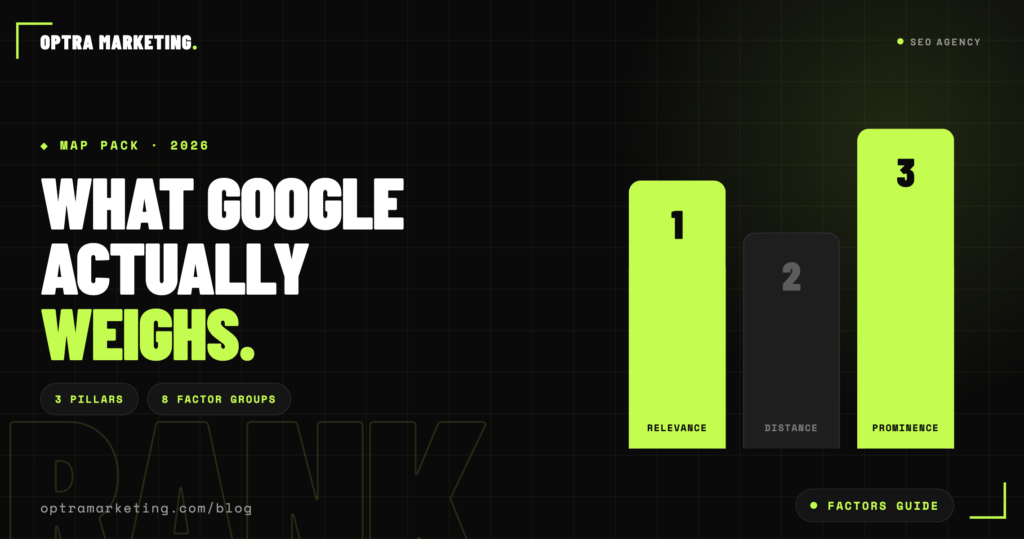
The Three Pillars Google Confirms
Google states that local results are based mainly on three things.
Relevance
How well your business matches what the person searched for. It comes from your categories, services, description, website content and reviews.
Distance
How far your business is from the searcher, or from the location named in the search. You can’t move your office, but you can make sure Google understands the areas you serve.
Prominence
How well known and trusted your business is. Google points to reviews, links, articles and directory listings as contributors, along with your position in organic results.
Every practical factor below feeds one of those three pillars.
Google Business Profile Signals
Your primary category is one of the most influential settings you control. It tells Google which searches you’re eligible for, so it should describe your core service as precisely as possible. A plumbing company that’s set as “Contractor” will struggle against competitors set as “Plumber.”
Secondary categories, a complete services list, accurate hours, photos and an active profile all add to relevance and trust. Verified, complete profiles consistently outperform thin ones.
The business name matters too, which is why so many businesses are tempted to add keywords to it. It can produce short-term gains, but it breaks Google’s guidelines and is a common route to a suspended Google Business Profile. There are ways to add keywords to your profile without breaking the rules that carry none of that risk.
Reviews
Reviews influence both rankings and whether people click. Count matters, but so do the average rating, how recently reviews arrived and how consistently they keep coming. Many practitioners also see a benefit when reviews naturally mention the service and location, such as “they replaced our water heater in Mesa the same day.”
Owner responses don’t appear to be a strong ranking factor on their own, but they shape how prospects read your profile. The way you reply to negative reviews in particular affects clicks and calls.
Proximity
Distance is the factor that frustrates businesses most, because it limits how far your map visibility reaches. A business usually ranks best close to its location and weaker further out, especially in crowded categories. That’s why so many businesses are visible in one city and missing in the next.
You can extend your reach through stronger prominence: more reviews, better location pages and more local links. But no amount of optimization will make a business rank across an entire metro area in a highly competitive category.
Your Website
Google cross-references your profile with your website. Dedicated service pages, genuinely local location pages, consistent contact details and LocalBusiness schema all support relevance. Backlinks from relevant local and industry websites support prominence, which is the job of focused link building.
The page your profile links to matters. Linking a single-location profile to a strong homepage, or a multi-location profile to the correct location page, helps Google connect the two.
Citations
Listings on directories such as Yelp, Apple Maps, Bing, the BBB and industry sites confirm that your business exists at the details you’ve given. Consistency is what counts. Their direct ranking influence has declined as Google relies more on its own data, but inconsistent citations still create confusion that can hold a profile back.
Engagement Signals
Google doesn’t publish details here, but it does say that prominence reflects how well known a business is. Many in the industry believe engagement, such as clicks, calls, direction requests and photo views, plays a role among Google Maps ranking factors. Whatever the exact weight, a profile that attracts engagement is a profile that wins business, so earning more clicks from local results is worth the effort either way.
Local Search Ranking Factors and AI Search
AI Overviews and assistants such as ChatGPT increasingly answer local questions directly. They tend to draw on the same signals: well-reviewed businesses, clear website content and consistent information across the web. That overlap explains why AI recommends some businesses and ignores others, and it means strong local SEO is also the foundation of AI visibility.
Frequently Asked Questions
What’s the single most important local ranking factor?
There isn’t one in isolation, but your primary Google Business Profile category and your proximity to the searcher have the biggest immediate effect. Reviews and website relevance are the strongest factors you can build over time.
Can I rank in the map results for a city where I don’t have an office?
It’s possible in less competitive categories, especially with strong reviews and a dedicated location page. In crowded markets, proximity limits how far your map visibility reaches, and organic results are often the more realistic target.
Do Google Business Profile posts improve rankings?
There’s little evidence they move rankings directly. They do keep your profile active and give searchers more reasons to choose you, which supports engagement and conversions.
Does having a keyword in my business name help?
It can, which is why it’s so commonly abused. If the keyword is genuinely part of your registered name, use it. Adding one artificially breaks Google’s guidelines and risks suspension.
How often do local SEO ranking factors change?
The core principles of relevance, distance and prominence have been stable for years. What shifts is how Google weighs individual signals, as the history of Google’s algorithm updates in local search shows. That’s why monitoring rankings regularly matters more than chasing every update.
Pinpointing the Factors Holding You Back
Knowing the local SEO ranking factors in general is useful. Knowing which two or three are keeping your business out of the top spots is what changes the phone bill. Optra Marketing begins every engagement by setting your profile, reviews, website and citations side by side with the businesses that currently hold the map pack, so the work goes straight to the gaps that will actually shift your position.
The Growth plan layers on a dedicated Google Maps ranking strategy and local citation building, the two areas where most businesses leave the most ground uncovered. That same map-first focus took one HVAC client from roughly 10 calls a month to more than 80 in four months. Request a free strategy call, and we’ll show you which factors are costing you a place in the top three.

2 Comments
Comments are closed.
[…] found what they’re looking for, and gives them a reason to choose you. Alongside the other local SEO ranking factors, it’s one of the clearest relevance signals on the page. For local businesses, that usually […]
[…] requests than those with a logo and nothing else. Since prominence and engagement are among the local SEO ranking factors that shape map results, photos contribute indirectly, and they directly affect how many searchers […]