
Website Redesign SEO: Redesign Without Losing Rankings
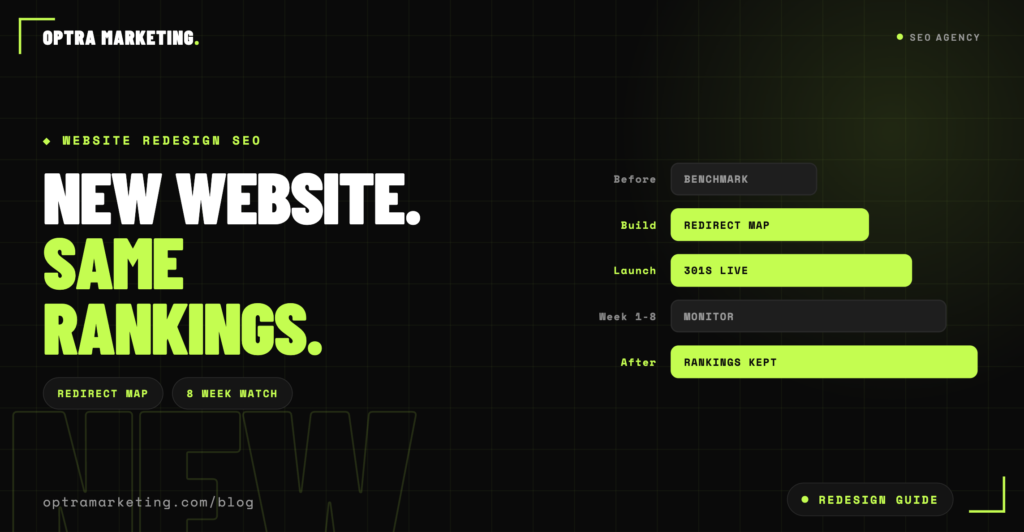
A new website should be good news. It looks sharper, loads faster and finally reflects the business you’ve become. Then, a few weeks after launch, the phone goes quiet and you discover your rankings have slipped, or that your website isn’t showing up on Google at all.
It happens to a lot of businesses, and it’s almost always avoidable. Redesigns don’t damage SEO by themselves. What damages it is everything that changes along the way without anyone tracking it: URLs, content, internal links and indexing settings. Good website redesign SEO is simply the discipline of tracking those changes.
Why Redesigns Cause Ranking Drops
Google ranks individual pages, not websites as a whole. Every page that ranks today has built up signals over time: links from other sites, a history of clicks, and content Google has learned to trust for certain searches. A redesign can break those signals in several ways.
- Pages move to new URLs without redirects, so Google and visitors hit dead ends.
- Content that ranked well is shortened or rewritten to suit the new design, and the keywords that earned the ranking disappear.
- Pages are merged or dropped because they didn’t fit the new menu.
- Internal links change, leaving important pages with fewer paths pointing to them.
- The setting that hid the new site during development, often a leftover noindex tag, is still switched on at launch.
Any one of these can cost rankings. Several at once can wipe out years of progress.
Before Design Work Starts
The most important SEO work in a redesign happens before anyone opens a design tool.
Record What’s Working Now
In Google Search Console, export your top pages and the searches they rank for. In Google Analytics, note which pages bring in the most visits and enquiries. These are the pages you can’t afford to lose.
List Every URL
Crawl your current site with a tool such as Screaming Frog, or export the list from your CMS. This becomes the foundation of your redirect plan.
Find the Pages Other Sites Link To
A backlink tool will show which URLs have earned links. Those URLs need to keep working, either as they are or through a redirect.
Share It With Your Designer
A designer who knows which pages and sections drive leads can build around them rather than cutting them.
How to Redesign Without Losing SEO During the Build
Keep URLs the Same Wherever You Can
If /drain-cleaning ranks well, the new site should use /drain-cleaning too. When a URL must change, add it to a redirect map: a simple spreadsheet listing each old URL and its new equivalent. Retire old folders completely, or you’ll end up with duplicate URLs splitting your rankings between the old structure and the new one.
Carry Over the Content That Ranks
Design can change around it, but the substance of a well-ranking service page should survive: the details, the FAQs, the local references. If you’re rewriting, improve it rather than trimming it.
Password-Protect the Staging Site
Protect the staging site with a password rather than relying only on a noindex tag. Password protection keeps it private without the risk of an indexing setting being copied to the live site.
Website Relaunch SEO: Launch Day Checklist
- Remove any password protection or search engine block from the live site.
- Put every redirect from your map live, and test a sample of old URLs to confirm each lands on the right page in one step.
- Check that title tags, meta descriptions and headings came across intact.
- Confirm your tracking, forms and click-to-call buttons work.
- Submit the new XML sitemap in Search Console and request indexing for your most important pages.
The First Eight Weeks After Launch
Some movement after launch is normal while Google recrawls and reassesses the site. What you’re watching for is sustained drops on specific pages.
Check Search Console weekly for new 404 errors and indexing issues, and compare traffic to your top pages against the benchmark you recorded. If a key page has dropped, compare old and new versions side by side. Usually the cause is visible: missing content, a broken redirect or a changed heading. Resolving those quickly limits the damage, and running the new site through a full technical SEO checklist about a month after launch catches anything that slipped through.
A redesign is also a natural moment to fix long-standing problems. Many of the local SEO mistakes that cost businesses leads, such as missing service pages or weak calls to action, are easier to solve when the site is being rebuilt anyway. If you’ve been in the frustrating position where you rank on Google but get no calls, the redesign is your chance to fix the conversion side too.
Frequently Asked Questions
Will my rankings drop after a redesign?
A small, temporary fluctuation is common. A significant or lasting drop usually means something was lost along the way, such as redirects, content or indexing settings, and it can be traced and fixed.
Should I change my URLs during a redesign?
Only if the current ones are genuinely poor, such as long strings of numbers or unclear names. Every changed URL needs a 301 redirect, and some value can be lost in the process, so keep URLs that already rank well.
Can I remove old pages that no longer fit?
Yes, but check them first. If a page ranks, gets traffic or has backlinks, redirect it to the most relevant new page rather than deleting it outright.
How long does it take rankings to recover if they drop?
If the cause is fixed quickly, rankings often recover within a few weeks of Google recrawling the affected pages. Problems left for months take longer to reverse.
When should an SEO specialist get involved in a website redesign?
Before design begins. Website redesign SEO is far cheaper when the site is built around existing rankings than when those rankings have to be repaired after launch.
A New Website Without Starting From Zero
Optra Marketing doesn’t sell redesigns, and if your current site is doing its job, we’ll say so plainly. But once you’ve committed to a rebuild, we sit alongside your designer or developer to guard the rankings you’ve already earned. That means benchmarking where every important page stands today, building the redirect map, inspecting the staging site before it goes live, and tracking each key page through the weeks that follow.
The result is a fresh look that keeps its footing in search. The technical SEO audit that underpins the whole plan is included in our Starter plan, and every plan runs month to month. Ideally, book a free strategy call while the new site is still on the drawing board, so nothing you’ve built gets lost at launch.

4 Comments
Comments are closed.
[…] website redesign on the same platform lets you keep most URLs exactly as they are. A migration usually doesn’t. Every platform […]
[…] and when they point to a 404 page, their value is largely lost. If you’ve been through a website redesign or a platform migration, there’s a good chance some of your best links now point to pages […]
[…] is simplified during a website redesign, and some pages lose the only links they […]
[…] redesign or platform migration is a chance to create new chains, so check them as part of the launch […]